The Quiet Power of a Hand-Crafted Tribute: Why a Custom Wool Felt Pet Replica Outlasts Any Photograph
There is a particular kind of silence that settles into a home after a beloved pet is gone. The collar still hangs by the door. The food bowl sits in its usual place. And somewhere, a folder on your phone holds hundreds of photographs — a lifetime compressed into rectangles of light. Photographs are a gift, of course. They freeze a moment. But if you have ever stood in a quiet room and longed not just to see your companion but to feel that they were there, you already understand the limitation of the flat image. A photograph tells you what your pet looked like. A hand-crafted tribute, shaped slowly by human hands in wool and wire, tells you that someone sat down and gave your pet their full, patient attention. That difference is not small. It is the difference between remembering and being with.
At PODPAWS, our custom wool felt pet memorial figurine in frame was born from this simple, tender idea: that some bonds deserve more than a picture. They deserve presence. They deserve texture under your fingertips and a little three-dimensional creature sitting on your shelf, catching the afternoon light the way your cat or dog once did. This is a custom pet portrait, but one you can lift, turn, and hold. In the pages that follow, we want to explore why that matters — not as a sales pitch, but as a reflection for any owner who has ever loved an animal as family.
Why a Photograph Sometimes Isn’t Enough
We are not here to argue against photographs. Most of us have a phone overflowing with them, and many of us have printed a few to frame. A good photo captures a glance, a tilt of the head, the exact shape of a yawn. It is a record, and records matter.
But a photograph is, by its nature, a surface. It is light reflected off a moment that no longer exists. When you look at it, you look at something. When you hold a needle-felted replica, you hold something that was made — built up strand by strand, shaped by a maker who studied your pet’s silhouette and decided, with every poke of the needle, what made them them. The object carries the residue of that attention. It carries time.
Consider, too, what a photograph asks of you. It asks you to supply the depth. Your memory does the work of filling in the weight of a body against your leg, the rasp of a tongue, the particular warmth of fur in winter. A photograph is a prompt for memory; a sculpture is almost a stand-in for the memory itself. It already has the roundness, the heft, the posture. You do not have to conjure those things from nothing. They are simply there, on the shelf, asking nothing of you and offering everything.
There is research, and plenty of lived experience, suggesting that tactile objects help us process loss. We reach for something solid because grief can feel like the ground dissolving. A thing you can touch becomes a small anchor. It says: this happened, this was real, and here is proof in your own two hands. A photograph can say the first two. Only an object can say the third.
This is part of why so many people who come to us describe our pieces as pet memorial gifts rather than decorations. A decoration is meant to be noticed. A tribute is meant to be felt, quietly, every day, often when you are not even consciously thinking about it. You walk past the shelf. You glance. And for a second, you are not alone.
The thing about presence
Presence is the word we keep returning to. Grief, especially pet loss, is rarely a single dramatic moment. It is a series of small absences — the empty spot at the foot of the bed, the silence when the mail arrives, the way the house feels too large. A flat photograph can acknowledge those absences. A three-dimensional object can, in a strange and gentle way, soften them.
Because the figurine has volume, it occupies the same kind of space your pet did. It has a posture. It has weight. It casts a shadow. When you place it on a mantel or a bedside table, it is not a picture of a creature in another time and place. It is a creature, here, now, in your home. That shift — from “look what was” to “here is something” — is the quiet power of the hand-crafted tribute.
What Needle Felting Actually Is (and Why It Takes Patience)
To understand why these pieces feel different, it helps to understand how they are made. Needle felting is an old, hands-on craft. The artist starts with loose wool roving — the raw, cloud-soft fiber sheared from a sheep — and uses a special barbed needle to repeatedly stab and tangle the fibers together. Each stab locks the wool into place. Do it thousands of times and a loose handful of fluff becomes a firm, sculptural form. Build that form up in layers, refine the contours, add the ears, the muzzle, the little paws, and slowly a recognizable creature emerges.
There is no mold. No printing. No shortcut. Every figurine at PODPAWS is built by hand from a single reference photograph, which means every one is irreducibly unique. The maker is reading your pet’s proportions, their coat direction, the set of their eyes, and translating all of that through their own hands into wool. It is slow work. A single piece can take many hours across several days. And that slowness is exactly the point.
When you commission something handmade, you are not buying a product off a shelf. You are asking a stranger to spend hours thinking about someone you loved. That act of deliberate, unhurried attention is itself a kind of honoring. The finished object is not just a likeness; it is evidence that your pet was worth that time.
From a Single Photo to a Three-Dimensional Companion
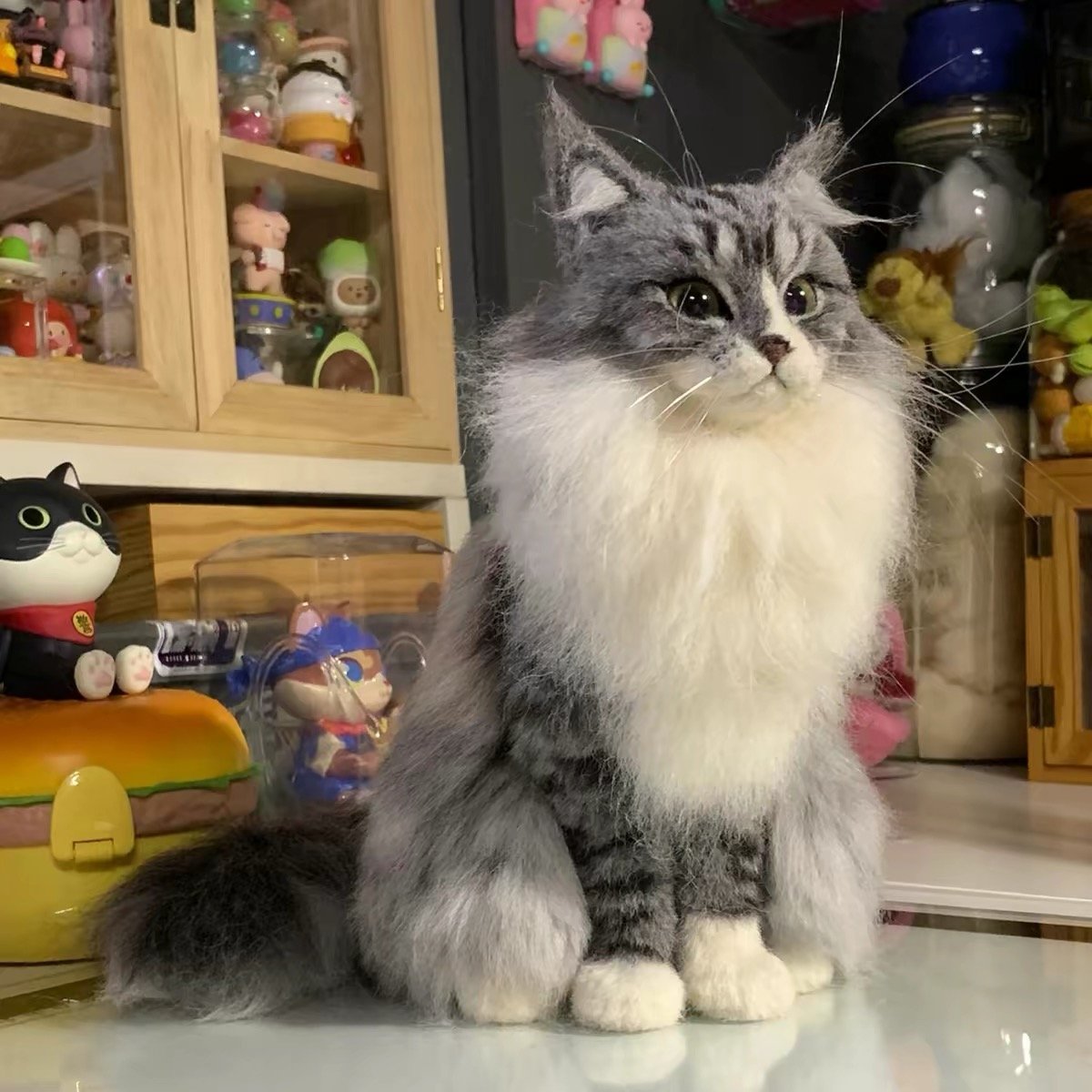
One of the most common questions we hear is: “Can you really make it look like them from just one picture?” The honest answer is that a good likeness depends as much on the right photo as on the maker’s skill. You do not need a professional portrait. You need a photo that tells the truth about your pet.
Choosing reference photos that read true
If you are thinking about commissioning a custom pet portrait in wool, here are the things we gently look for in a reference image:
- A clear, unobstructed view of the face. The eyes and muzzle are where likeness lives. A photo where your pet is looking toward the camera — even at a slight angle — gives the maker the most to work with.
- Good, even lighting. Harsh shadows or a blown-out flash can hide the very features that make your pet recognizable. Soft natural light is ideal.
- The real coat color, not a filtered one. We love a sunny Instagram filter as much as anyone, but for a faithful sculpture we need to see your pet’s true coloring and markings.
- A posture that feels like them. Was your dog a leaner, always pressing into your leg? Was your cat a loaf, compact and content? A photo that captures a characteristic pose will read as “them” far more than a perfectly posed studio shot.
- Markings and quirks. The white blaze, the mismatched socks, the one ear that flopped differently — these are the fingerprints of individuality. Point them out if you can.
Many owners send us two or three photos: one for the face, one for the body and coat, and one that simply captures their personality. That combination lets the maker build not just a resemblance but a character.
What makes a likeness read true
There is a subtle distinction here worth naming. A likeness is not the same as a perfect copy. A photocopier can copy; only a human maker can recognize. The reason a hand-felted figurine often feels more “like them” than a technically perfect rendering is that the maker is making thousands of tiny interpretive choices — where to add a touch more wool to round a cheek, how to angle the ears a hair lower, the exact tilt of the head that says this is your dog.
The best tributes are not the most anatomically precise. They are the ones that capture the gesture of the animal. A cat mid-stretch. A dog with the soft, hopeful leaning-forward posture of someone who expects a walk. These are the details that make you catch your breath when you unwrap the box, because for a moment your brain insists: that is them.
The Maker’s Hand: What Goes Into Reading a Face
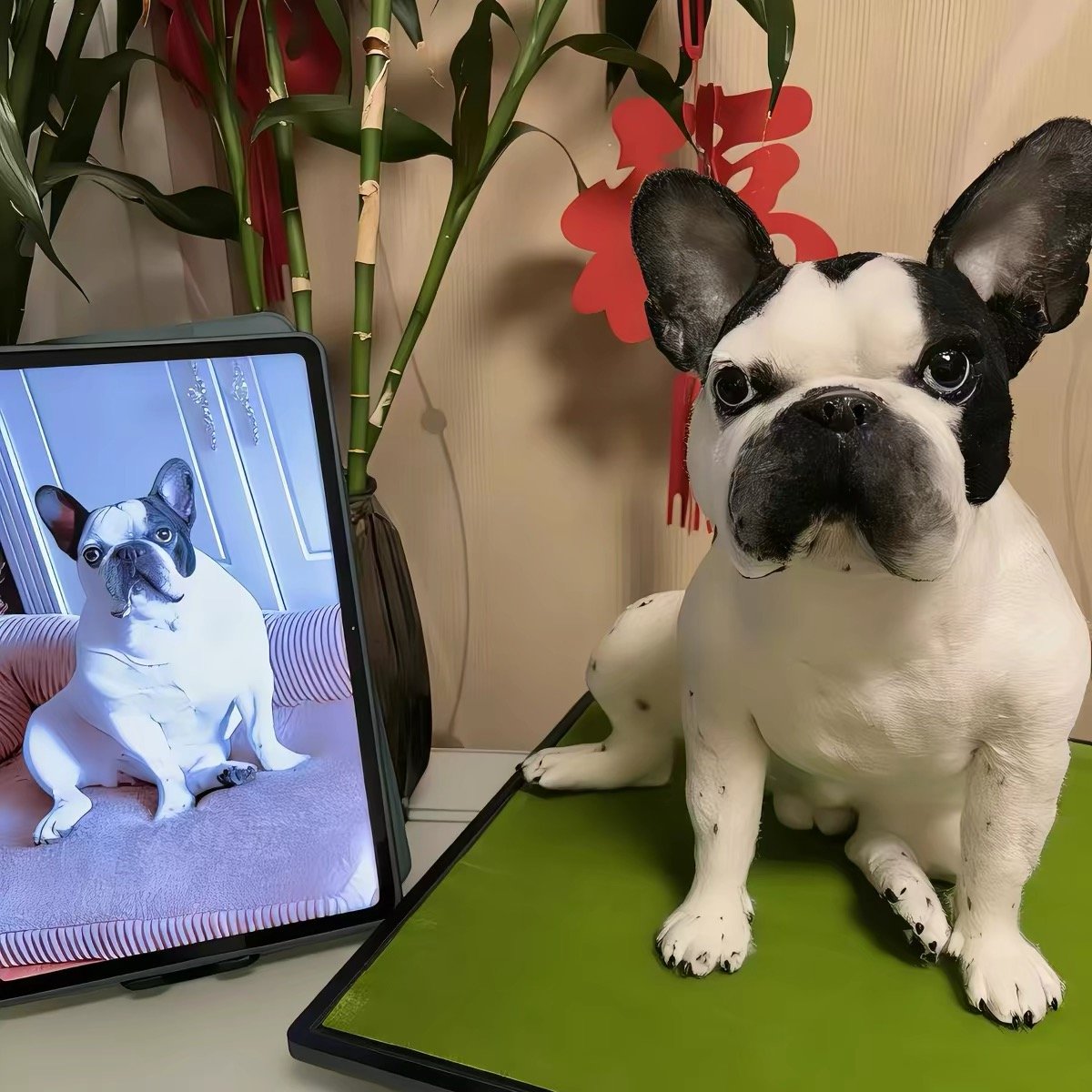
It is worth pausing on the human at the other end of the commission, because their role is larger than most people imagine. When your photo arrives at the studio, the maker does not simply start stabbing wool. First comes a long, quiet study. They trace the outline of the head. They measure the ratio of muzzle to skull, the placement of the eyes, the width of the cheek. They note where the coat lightens and where it stays dark. They look for the asymmetry that makes a face a someone rather than a generic cat or dog.
Then the building begins, and it is slower than it looks. The core body is shaped first, usually around a small armature so the figure can hold a pose without collapsing. Then the head, then the features, each refined in passes. The eyes are often the hardest — get them a millimeter off and the whole creature looks like a stranger. Makers will tell you they spend a disproportionate share of their hours on the eyes alone, because the eyes are where recognition happens. You do not recognize a pet by their paws. You recognize them by the way they look at you.
There is a humility to this work that we think owners should know about. A good maker is not trying to impose a style. They are trying to disappear — to become a transparent channel between your photograph and the wool. The ambition is not “look how skilled I am” but “look, it’s your dog.” That self-effacement is itself a form of respect for the animal being portrayed. It is also why no two makers, working from the same photo, would produce the same piece. The hand always leaves a trace, and that trace is part of the warmth.
The Ritual of Commissioning: Slowing Down to Remember
There is another quiet benefit to a handmade tribute that people rarely expect. The act of commissioning one becomes its own small ritual of remembrance.
Think about what you do when you decide to make one. You open your photo library and you look — really look — through years of images. You revisit the day at the beach, the first winter, the ridiculous Halloween costume, the calm last days. You choose the photo that says home. You write a few words to the maker about who your pet was. You wait, and in the waiting, you remember.
In a culture that rushes us past grief, that pause is a gift. The commission is not a transaction; it is a few weeks during which your pet is the center of someone else’s careful attention too. By the time the finished piece arrives, you have not just received an object. You have spent a season honoring a life. For many, that is why these pieces function so well as a pet loss gift — given to a grieving friend, it says: I see your loss, and I think it deserves to be marked with care.
We have heard from people who commissioned a figurine not for themselves but for a partner, a child, or a parent who was struggling to let go. The giver often worries it will be “too much,” too sad a reminder. Almost uniformly, the opposite happens. The recipient cries, of course — but they cry in the relieved way people cry when their love has been witnessed. To be given a handmade likeness of a pet is to be told, without a single heavy word, that your grief is legitimate and your bond was visible to others. That is a rare and tender thing to receive.
“A handmade object is a record of human attention. When that attention was given to someone you loved, the object becomes a kind of warmth you can keep.”
Why Handmade Objects Carry Story
There is a reason humans have always made objects by hand to mark what matters. We carve headstones. We weave mourning ribbons. We stitch quilts from a loved one’s shirts. The machine can produce a thousand identical things; the hand produces one thing that carries the story of its making. You can feel it, somehow, even if you cannot name it. The slight imperfection is not a flaw. It is a signature. It is proof that a person was here, doing this, for you.
A wool felt figurine is warm to the eye in a way plastic and resin are not. Wool has a softness, a variance, a living quality. It catches light the way an actual creature’s fur does. And because it is built from loose fiber rather than poured into a mold, no two will ever be the same — not even if you ordered two of the same pet. The maker’s hand introduces a humanity that mass production cannot.
This is also why these pieces sit so comfortably alongside the other ways people remember. They do not replace the photographs or the collar or the favorite toy. They join them. They become one more thread in the weave of memory — one that happens to have dimension and presence and a place on the shelf where the light falls just so.
Choosing the Right Tribute for Your Story
A wool felt figurine in a frame is one kind of custom pet memorial gift, and for many owners it is exactly right: a likeness they can see and hold, displayed like the portrait it truly is. But it is worth naming that every family’s need is different, and the right tribute is the one that fits your own way of remembering.
For some, the need is to keep a physical part of their companion close. In those cases, our custom cat & dog ceramic pet urn offers an airtight, moisture-proof ceramic keepsake — a quiet, dignified vessel for ashes that sits gracefully in a home rather than hidden away. It is a different kind of presence, one rooted in the decision to let a pet’s remains remain part of daily life.
For others — especially those not facing loss but simply wanting to celebrate the bond — our pet & owner matching necklace (double wear style) speaks a lighter but no less true language. Worn by both pet and human, it is a small daily symbol of the connection that needs no occasion to be honored. Grief and celebration are not opposites; they are two faces of the same love.
What unites all three is the thing we keep coming back to: personalization. None of these is a generic product with a pet printed on it. Each is made for a specific animal, by specific hands, from a specific life. That is what makes them personalized pet gifts in the truest sense — not monogrammed, but known.
If you are unsure which form of tribute fits your situation, a simple question helps: what do you most want to do with the memory? If you want to see them daily in a form you can hold, the wool figurine is your answer. If you are keeping ashes and want a vessel that belongs in the living room rather than the back of a closet, the ceramic urn holds that role with quiet dignity. If your pet is still with you and you simply want to wear the bond, the matching necklace keeps the connection literally close to the skin. None is better; they are simply different answers to the same love.
A Few Gentle Thoughts on Living With Your Tribute
Once your figurine arrives, you may wonder where it should go. There is no correct answer, only the one that feels right. Some owners place it where their pet used to sleep. Others keep it on a desk, where a glance upward offers a small steadying comfort during a hard day. Children especially seem to understand these objects — they treat the little wool creature as a continued presence, a way to keep talking to a friend who left.
A few practical notes, offered with care:
- Keep it out of direct, prolonged sunlight to preserve the wool’s color over the years.
- Dust gently with a soft brush; wool prefers a light touch.
- Consider the frame as part of the piece. The frame is not just packaging — it sets the figurine like a portrait, gives it a “home,” and protects it from curious hands or paws.
- Let it evolve in meaning. The piece you receive in the raw early weeks of grief will mean something different a year later. Both meanings are true.
The Long Quiet After
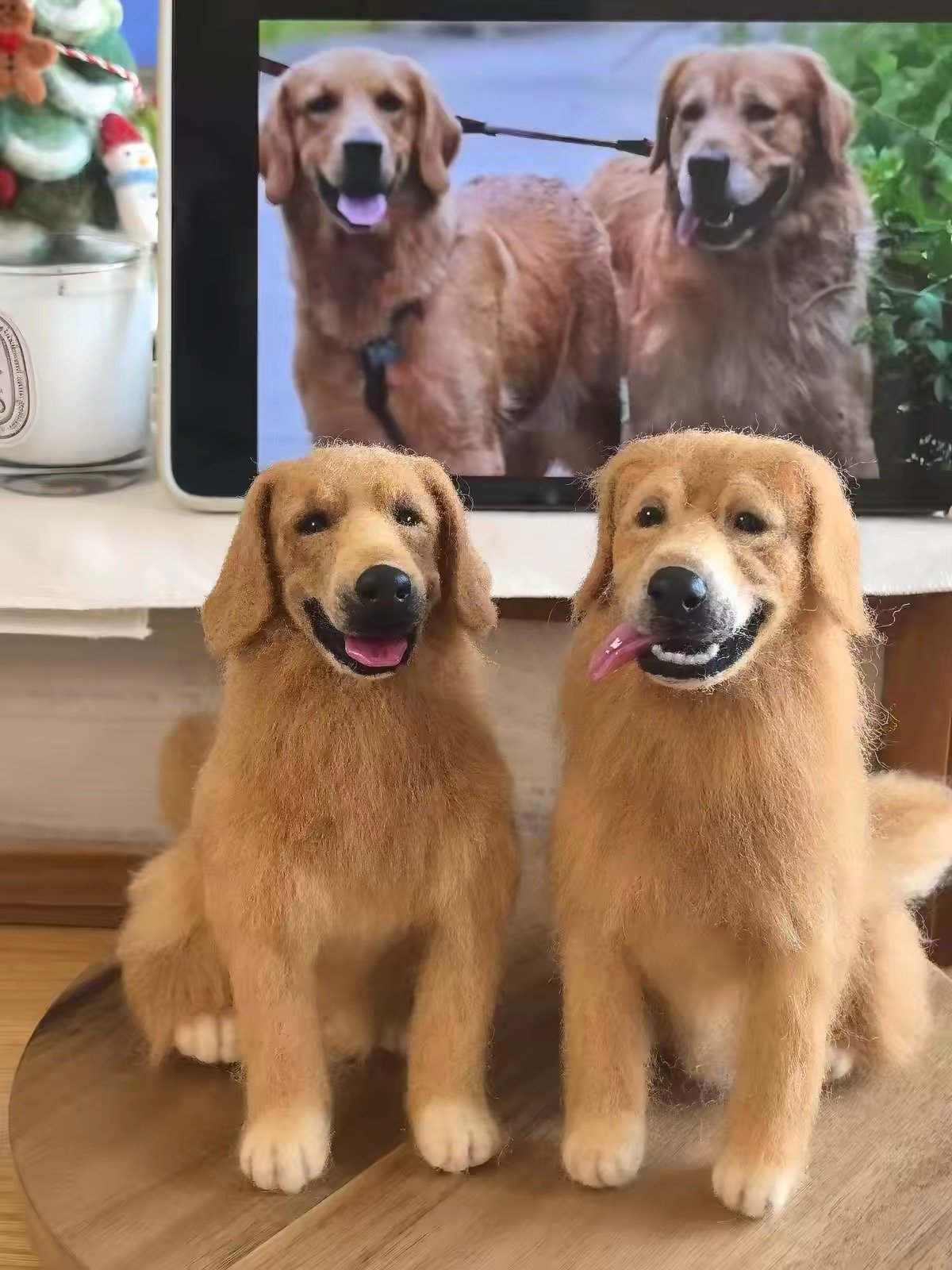
We said at the start that there is a particular silence after a pet is gone. What we have learned — from our own makers, and from the owners who write to us — is that the silence does not stay empty forever. Slowly, gently, it fills. With memory. With the stories you tell out loud. With a small wool figure on the shelf that seems, somehow, to be listening.
A photograph will always be precious. But a photograph is a window. A hand-crafted tribute is a doorway — one you can walk through whenever you need to, and find your companion waiting, made of patience and wool and the unmistakable shape of love.
If you are holding a phone full of photos and a heart that is not quite ready to let go, perhaps that is the invitation. Choose the picture that says home. Send it to someone whose hands know how to listen. And let a little three-dimensional likeness take its quiet place in your life — outlasting the flat image, not because it is better, but because it was made, and making is its own kind of love.
That is the quiet power of a hand-crafted tribute. Not louder than grief. Just gentler, and longer-lasting, and there when you need it most.