A Lit Frame or a Flower Box? Choosing Between Two $89 Memorial Gifts
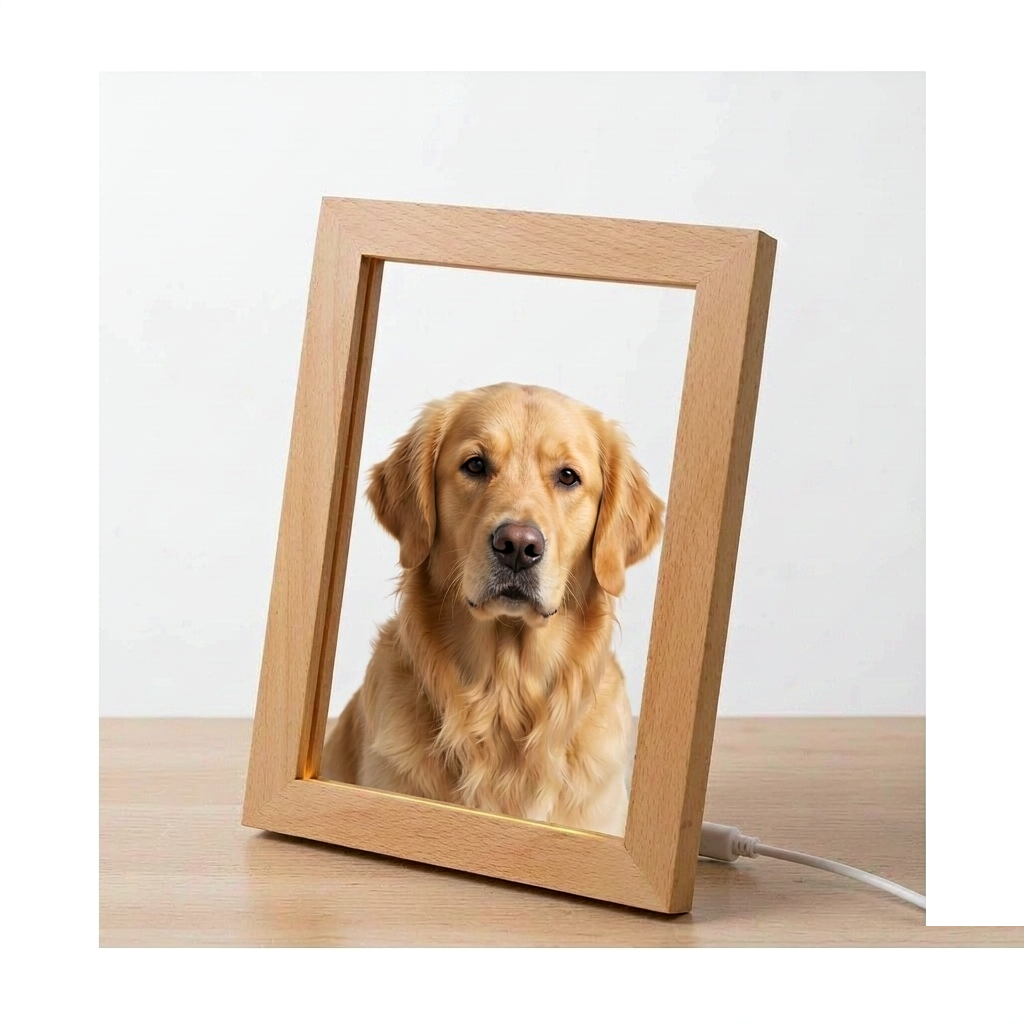
The shadow box vs frame decision is not about taste — it is about whether you are keeping objects or keeping a photograph. Two of our memorial displays cost exactly the same, $89, and they are built around opposite ideas. One is a light source with a photograph behind it. The other is a glass case with objects sealed inside it, lit from within. Here is how to tell which problem you are actually trying to solve.
They are not variants of the same product. They do completely different jobs, solve different problems, and suit different rooms and different people. This guide sets them against each other honestly, including where each one is the wrong choice, so you can work out which problem you are actually trying to solve.
What Each One Actually Is
The backlit frame is 23 cm wide by 16.5 cm tall, in pale wood grain. A single-color LED glows evenly from behind an acrylic panel printed with your pet’s photograph, powered by a thin USB cable. It is a light. Its primary output is illumination — the photograph is the thing being lit.
The lit shadow box is deeper and comes in three sizes — 20, 25 and 30 cm. Behind glass, mounted on a pale wood frame, it holds pressed dried flowers and your pet’s photograph, with a warm LED strip washing the interior. It is a case. Its primary output is a composition — several elements arranged together behind glass.
That difference propagates into everything else.
Where Each One Goes
This is the single most useful question, and it usually answers itself faster than any feature comparison.
Choose the frame for a wall you want to see at night. Bedrooms, hallways, a dark living room corner, a kitchen after dinner. The frame’s whole effect depends on darkness; in a brightly lit room during the day it reads as an ordinary photograph in a wooden border, which is fine but unremarkable.
Choose the shadow box for a surface you look at during the day. A console table, a shelf, a sideboard where the keys go, a desk. It needs ambient light to read, because the arrangement inside is doing the work rather than the glow. It also needs somewhere to stand — it is a three-dimensional object with depth, and it occupies shelf space in a way a flat frame does not.
If you are unsure, the failure mode tells you. People who put the frame somewhere bright report that it “does nothing,” which is correct behavior. People who put the shadow box in a dark hallway report that the photograph is hard to see, which is also correct behavior.
What You Are Actually Looking At
The frame shows one image, large. The acrylic panel is printed with a single photograph. At 23 cm wide the image is legible from across a room in low light, and it is the only element. There is nothing else to look at, which is a feature when you want one thing.
The shadow box shows a composition of several things. Pressed dried flowers, a small printed photograph of your pet, and the warm wash of the interior light. The arrangement is what carries the eye. For some people that reads as richer; for others who want the photograph to dominate, the surrounding botanicals compete with it.
There is a version-control point here too. If your pet is a dog, their face is often the whole point, and a photograph that stands alone communicates faster. If your pet was a cat and you have pressed flowers from the garden they sat in, the composition carries meaning the photograph alone cannot.
Photography: Where They Differ
The frame is unforgiving of a soft image. A backlit panel is a light source, and a soft photograph blown out by that light looks genuinely bad. Fine fur detail disappears; the face becomes a pale blur. The photograph needs to be sharp, well-exposed and free of heavy filters.
The shadow box is more forgiving. The photograph inside is smaller relative to the whole object, and it is not the light source — the LED is behind it, not behind the photograph’s own subject. Some loss of detail is masked by the surrounding arrangement.
This matters more than it sounds. If your best photograph of your pet is soft or filtered, the frame is genuinely difficult and the shadow box is the safer choice. We will not pretend otherwise in a comparison piece.
Size, Weight and What That Means
| Backlit frame | Lit shadow box | |
|---|---|---|
| Price | $89 | $89 |
| Size | 23 × 16.5 cm | 20 / 25 / 30 cm |
| Weight | Light, wall or surface | ~560–650 g at 20 cm; ~720–790 g at 25 cm |
| Depth | Thin | Deep enough to be a shelf object |
| Power | USB cable | Wired LED strip |
| Holds ashes | No | No |
The shadow box is meaningfully heavier. At 25 cm it is most of a kilogram, which is fine on a console table and worth knowing before you mount anything.
The frame is a wall-mountable object as much as a free-standing one. That is a real functional difference: the shadow box generally does not want to be on a wall, because a shadow box hung on a wall reads as a picture frame that happens to be deep, and it loses what makes it work.
The Maintenance Question
Neither requires upkeep in any meaningful sense, but they differ in what happens over time.
The frame has an LED behind a panel. The panel is a printed acrylic surface, which cannot yellow or fade the way a paper print can. Dust on the front is a wipe with a dry cloth. The main long-term consideration is where you put it — a panel is fine indefinitely.
The shadow box seals botanicals behind glass, which protects them completely. Some people notice that pressed flowers slowly fade in color even behind glass, because they are dried plant material and light still reaches them. Keeping it out of direct sun will preserve the color much longer. The frame and the glass need no attention.
What They Do Not Do
Both are display objects. Neither holds ashes. If that is what you are solving for, this comparison is the wrong page — an urn is the answer, and the capacity question is a different decision entirely.
Both also do not travel. Neither has a keyring version. If you need something that goes on a set of keys or in a bag, neither of these works and you are looking at a different category of product entirely.
It is also worth saying clearly: $89 is not a discount on these. It is the price of both. The comparison is not which is better value for money, because they cost the same. It is which one addresses your situation.
Who Each One Suits
The frame suits someone who wants one photograph visible at night, in a darker part of the house, and who has a sharp photograph of their pet. It also suits a smaller space, since 23 cm is compact for a lit display and does not dominate a wall.
The shadow box suits someone who wants an arrangement rather than a single image, who has pressed flowers with some connection to their pet, and who has a shelf or console in a daylit part of the house. It also suits a larger space, since the 25 and 30 cm versions have presence.
If you are choosing on the photograph alone and not on the space, the frame is the safer default. It is the simpler object and there is less that can go wrong with it.
If you are choosing because you want something that looks considered rather than functional, the shadow box is the more decorative of the two. That is not a criticism; decoration is a legitimate reason.
How the Two Compare to Everything Else at This Price
Because $89 sits in the middle of our range rather than at the top, it is worth knowing what the alternatives at and around that price actually are. Most of the confusion in this category comes from comparing a lit display against objects that do not light at all.
Under $50 — objects that travel or hold material. A 1.5 × 2.5 cm metal urn charm on a split keyring holds a share of ashes. A 6 × 9 cm suede paw-print keyring holds a tuft of fur behind a small window and travels in a pocket. A 4 × 3.5 cm leather photo keychain carries a color print on one face and an engraving on the reverse. A white glazed ceramic dish with a gold rim holds rings, small keepsakes or a modest amount of ashes.
None of these are displays. They are worn, carried and used. If the problem is “I want them with me rather than on a wall,” they are the correct category and neither $89 piece competes with them.
$59–$79 — pieces that hold. A compact matte-black ceramic urn, 6 × 8 cm, printed with a photograph and the name and dates. A slate garden stone, 15 × 20 cm, engraved, for a graveside or garden plot. A round stained-glass suncatcher in 15 to 30 cm, which uses sunlight rather than electricity.
The suncatcher deserves a mention here because it is the one display that competes with these two on equal terms and is cheaper. It throws colored light through hand-cut glass and copper-foiled lead lines, so it works in daylight and needs no power at all. What it cannot do is show a photographic portrait with any fidelity — it is an interpretation of your pet’s colors and outline, not a likeness.
$189 and above — three-dimensional sculpture. A photorealistic resin portrait bust, 2.5 cm tall, sculpted from your photograph with a keyring loop. It holds nothing, travels anywhere, and depends on facial detail to work.
The practical summary: if you want an object that lights up, your choice is between these two. Everything else at this price is solving a different problem.
Buying This as a Gift
Both $89 pieces are given reasonably often, and the gift version has different failure modes than the self-purchase version.
The frame is the safer gift. It is lighter, cheaper to ship, requires one photograph and one decision, and arrives as a self-contained object that needs no assembly. Someone who has lost a dog and has a spare photograph on their phone can receive it and know exactly what to do.
The shadow box is the more personal gift, because it implies knowing something about the person — that they pressed flowers, that they have a garden, that they care about arrangement. It also requires them to have a suitable surface, which you cannot verify.
Two specific things that go wrong:
Gifting a photograph-based piece without asking whether they want one. Some households already have several photographs of their pet on the wall, and a fourth framed image solves nothing. Others have deliberately kept the number low because a wall of photographs is hard to look at. Ask.
Gifting either one in the first month after a loss. It will be received as an instruction to feel something, which is not what anyone intends. The first six weeks are when people genuinely cannot look at a memorial object. If the occasion demands a date — a birthday, an anniversary — the two $89 pieces are among the few memorial products you can produce quickly enough, but consider whether it is the right month.
If you are unsure about the timing, a small object that carries a photograph on a keyring does the same work, costs less, and is much easier to receive. It can be given in the first month without the weight.
The Failure Modes, Listed Honestly
Every product in this category has a way of disappointing. Knowing them in advance is more useful than discovering them afterwards.
The frame in a bright room. Not a defect, a mismatch. A backlit panel needs darkness to read. In a room with daylight and no dimmable lighting, the LED is either invisible or an annoyance that gets switched off at the wall.
The frame with a soft photograph. This is the real risk. The panel is a light source, so a low-resolution or heavily filtered image gets blown out by its own backlight. The face washes toward white and fine fur detail is the first thing lost.
The shadow box in direct sun. Glass protects the contents from dust and handling, not from ultraviolet light. Pressed flowers fade faster in a south-facing window. Over years, a botanically colored arrangement drifts toward beige.
The shadow box on a high shelf. It weighs around 600 to 800 g and it is deep. It needs a surface with a front edge, not a narrow ledge, and it needs to be at eye level or slightly below for the arrangement to read rather than foreshorten.
Both, hung too high. Either object mounted above eye level means the photograph is being looked at from below, which foreshortens the face. For a memorial object this matters more than it would for a landscape photograph.
Both, in a room with no other reference to the pet. A single object in an otherwise neutral space can read as slightly odd rather than personal. These pieces work better alongside something else — a photograph, a bowl, a sculpture — that establishes what the room is about.
Where Each One Fails for a Specific Animal
Worth noting, because the photograph requirement differs and people only find out afterwards.
Flat-faced breeds and both pieces. Pugs, bulldogs, Persian cats — the face is nearly all depth and very little outline. A profile photograph of a flat-faced animal gives a silhouette that is hard to read in any medium, and a shadow box composition makes it worse because the flowers become the recognisable element. For these animals, a front-facing photograph carries more information, even though profile is normally the better advice.
Very fine-haired animals and the frame. Long-haired cats, Afghan hounds, small wire-haired dogs. The detail that makes them recognisable is soft texture, and a backlit panel reduces texture contrast. A shadow box is the safer medium because the printed photograph is smaller and the arrangement carries detail instead.
Black or dark-coated animals and the frame. A backlit panel behind a dark subject reduces contrast, and dark fur against a lit background loses its edge. This is a photograph preparation issue before it is a product issue — which is exactly the kind of thing worth raising before ordering rather than after.
White-coated animals and the shadow box. A pale photograph behind glass next to pale dried flowers has low contrast, and the image recedes. A darker botanical arrangement fixes it.
A Note on the Price Itself
$89 for a made-to-order display is not a sale price and it is not a premium one. It reflects the making: a printed acrylic panel or a printed photograph behind glass, a wooden frame, a wired LED, and a photograph that has been prepared by hand and confirmed before anything is assembled.
The comparison worth making is with the $499 hand-painted ceramic urn, which is roughly five and a half times the price because it is painted one at a time after firing. Neither is better than the other. They are different objects with different capacities and different jobs, and the price difference reflects labor rather than quality.
Anyone who tells you a lit frame at this price is overpriced is comparing it against a mass-produced frame with a printed insert, which is a fair comparison for a different product.
What the Photograph Needs Either Way
Because both products are made from one image, the same guidance applies.
One clear face, unblocked. Not a group shot, not a photo where your pet is half out of frame.
Eye level, side-on light where possible. Profile photographs give a clean outline. Light from the front flattens a face.
Leave a little around the head. A tight crop loses the ear outline and shoulder that carry the proportions. The maker needs those to read the shape correctly.
Do not send a heavily filtered image. Beauty filters smooth fur direction and remove the small marks that make a face recognisable. A straight, slightly overexposed phone photograph is more usable than a polished one.
If you have several photographs, send one to be made from and note the others as reference. One is what gets produced.
Ordering, Timing and Cost
Production runs 7 to 10 business days after you approve the artwork, not after you pay. You will see a layout before anything is made — that is the point at which composition, name and dates get checked. Nothing is assembled until you confirm.
Then shipping is a flat $60 worldwide and transit is 15 to 25 days. Total from approval to arrival is roughly four to six weeks.
The flat $60 means the shipping cost is identical for a $39 pendant and a $649 urn, which matters if you are ordering more than one thing.
Both are made to order and cannot be returned once made. If you are uncertain, the honest answer is to decide before you order rather than hoping to change it.
If You Are Still Stuck
One question resolves it: what is already in the room?
If there is a photograph of your pet on the wall already, you do not need another photograph of your pet. You need something that adds an element — which points to the shadow box, where the photograph is one part of a composition rather than the whole object.
If there is nothing, and a dark wall or a bedside table is calling out for something, the frame is the right answer and the cheapest decision.
If you have a shelf and pressed flowers from anywhere in your life — a garden, a wedding, a bouquet that dried out — the shadow box has something to work with and the frame does not.
If You Are Ordering Both
Worth considering, because the two were designed around different spaces and are not redundant. A frame in a bedroom and a shadow box on a downstairs console is two objects doing two jobs in two rooms, and nobody would describe that as too much.
Two practical points if you do order both.
Split them across the approval cycle. Each piece needs its own layout approved. Ordering them together means two approval emails, which is more attention than people expect — but it does not lengthen the total, because production runs in parallel rather than in sequence.
Shipping is the same flat $60. Ordering two things together costs one $60, not two. That is worth knowing: two $89 pieces in one order carry $60 of shipping, so a combined order costs $178 delivered. The same two pieces ordered separately, at two different times, would carry $120 of shipping between them. If you already know you want both, ordering together is the obvious arithmetic.
The photograph can be the same for both. One good photograph works for the frame and for the shadow box. You are not choosing between two different images, so the decision about which photograph to use gets made once.
What These Two Do Not Replace
A short list of things people look for here and find somewhere else, so nobody wastes a search.
Holding ashes. An urn, sized by your pet’s body weight. This is a capacity decision, not a display decision.
Outdoors. Neither piece belongs outside. A slate garden stone, 15 × 20 cm and engraved, is the outdoor option; slate weathers and does not fade.
Carrying. A photo keychain or a paw-print keyring goes in a pocket and on a bag. Neither of these does.
Matching jewelry. If the person already wears a pet-themed necklace, adding a second worn piece is a different gift entirely and neither of these fits it.
The catalog is arranged so that most of these questions resolve in one place, but this page answers one question only: which of two $89 displays to buy. If your question is a different one, the honest answer is that a different product will serve you better than either of these.
Working Through the Decision in Two Minutes
If you have read the above and are still holding both in your hands, this is the shortest reliable route.
Step one: look at the room, not the products. Where is the darkest part of your home? Where is the shelf that already has something on it? A frame needs darkness; a shadow box needs a surface. This eliminates one of them immediately.
Step two: check your photograph. Open it full size. Is the face sharp, or is it soft and heavily filtered? Sharp points to the frame. Soft points to the shadow box.
Step three: ask whether there is a photograph already. If there is, the frame is duplicating something. Choose the shadow box, which adds botanicals rather than another image.
That is the whole decision. Everything else — LED color, wood finish, depth, weight — is a matter of taste rather than suitability, and taste is not something a specification can settle.
If you are still torn after those three steps, the honest advice is that both are defensible objects that cost the same and do different jobs. Choose the one that matches a room you already have, not the one that sounds better described.
Common Questions
Is a shadow box better than a backlit frame for a pet memorial? Neither is better as such. A shadow box holds a composition of pressed flowers and a photograph and reads best in daylight on a surface. A backlit frame shows one photograph as a light source and reads best in a dark room at night. The deciding factor is the room, not the product.
What is the best pet memorial gift under $100? For a dark room or a bedside table, a backlit acrylic frame. For a shelf in a daylit room, a lit dried-flower shadow box. Both sit at $89. If you want something carried rather than displayed, a photo keychain under $70 does different and equally valid work.
Do either of these hold ashes? No. Both are display objects built from a photograph. Holding remains is a separate decision, and the vessel needed depends on your pet’s body weight.
Can I hang a shadow box on a wall? You can, but it will not work as well. A shadow box needs depth and ambient light to read as a composition. Hung flat on a wall it reads as a deep picture frame and loses the arrangement.
Will a backlit frame wash out a dark photograph? It can. A panel lit from behind reduces contrast on a dark subject. This is handled in photograph preparation before the panel is made, which is worth raising when ordering rather than after.
How long does a custom memorial display take to arrive? Seven to ten business days of production after you approve the layout, then 15 to 25 days transit. Roughly four to six weeks. The order cannot ship until the layout is approved, so a week of not checking your email adds a week.
A Short Version
Both cost $89 and neither is the better-value option, because they are the same price. Choose the frame if you want one photograph visible at night and you have a sharp image. Choose the shadow box if you want a composition of flowers and photograph on a shelf in daylight, and you have botanicals with some connection to them. If your photograph is soft or heavily filtered, choose the shadow box — the backlit panel will not forgive it.
If you want both, they were designed to sit in the same house: the frame in a bedroom, the shadow box on a console downstairs. Nobody will think they are redundant, because they do different work.
The Two Pieces Compared Here
- Framed Acrylic Night Light with Pet Photo – Warm Backlit Wooden Photo Frame
- Dried Flower Shadow Box with Warm Light – Framed Pet Photo & Keepsake Display
- Stained Glass Pet Portrait Suncatcher – Round, Hand-Painted Glass Photo Keepsake
- Custom Pet Memorial Urn – Compact Black Ceramic Ash Urn with Photo, Name & Dates
Each piece is made to order from one photograph, so the choice between them is where it sits, what it is made of, and whether it holds anything.
Pieces Mentioned Here
Every piece is made to order from your own photograph, so no two are the same.
Questions People Ask
- Is a shadow box better than a backlit frame for a pet memorial?
- Neither is better as such. A shadow box holds pressed flowers and a photograph behind glass and reads best in daylight on a surface. A backlit acrylic frame shows one photograph as a light source and reads best in a dark room at night. The room decides it, not the product.
- What is the best pet memorial gift under 100 dollars?
- For a dark hallway or a bedside table, a backlit acrylic frame. For a shelf in a daylit room, a lit dried-flower shadow box. Both are eighty-nine dollars. If you want something carried rather than displayed, a photo keychain does different and equally valid work.
- Do lit pet memorial frames or shadow boxes hold ashes?
- No. Both are display objects built from a photograph. Holding remains is a separate decision, and the vessel required depends on your pet's body weight.
- Will a backlit frame wash out a dark photograph?
- It can, because a panel lit from behind reduces contrast on a dark subject. This is handled while the photograph is prepared, which is worth raising when ordering rather than after it arrives.