The First Pet Memorial That Actually Helps
A first pet memorial does not need to be permanent, expensive, or even an urn — it needs to be one object you can put down somewhere and look at. Most pet memorial advice is written for the person who has already grieved: shadow boxes, engraved stones, the symbolism of a paw print. It skips the two weeks that matter most, the part where you have a container of ashes on the kitchen counter and no idea what you are supposed to do next.
This guide starts there instead. It covers what actually has to happen in the order it has to happen, what most people wish they had kept, and how to choose something for your specific situation without spending money on the wrong object. There is no story in here about a customer whose dog looked wonderful in the frame. That would be invented, and you would be able to tell.
The First Week Is Admin, Not Grief Work
There is a temptation to treat this as a reflective process. In practice it is paperwork with a deadline, and the paperwork is easier if it gets done in the right order.
Confirm the decision. Most households discuss it as a family; some cannot agree for weeks. A cat that was one person’s cat can be a subject of genuine conflict between people who all loved it. If that is your situation, decide who has the authority to sign, and get the clinic to tell you what paperwork they need from that person specifically. Clinics deal with this routinely and can tell you exactly which form is missing.
Ask the clinic what they have already arranged. Many clinics have a standing arrangement with a crematorium and will handle the transport. Others hand you a list of local options and expect you to call. Know which situation you are in before you assume anything, because the difference can be several days.
Ask about the container. This matters more than it sounds. You will be handed something to bring home — usually a scatter tube, a plain wooden casket, or a polymer box the crematorium chose rather than you. None of these are made to be displayed. Some are explicitly marketed as temporary. Knowing this before you get home saves you from treating the container as permanent by default.
Ask whether you can have the ashes in a sealed liner. Most crematoriums will return remains sealed inside a plastic liner, which means you are not handling anything directly. This is worth requesting explicitly — some return loose, and if you are not ready to handle it, that matters.
Ask what the capacity will be. Or rather, ask what your pet weighed. The weight determines the volume, and the volume determines everything you buy afterwards. If you cannot bear to ask for the weight, your clinic can usually give it to you from the last visit record, and that is the same figure the crematorium uses.
That is genuinely all of week one. No urn, no memorial, no photograph to choose. It is logistics, and it is unglamorous, and it gets done.
What Actually Comes Back
This is the part almost nobody explains, and it is the single most useful thing to know before you spend anything.
Cremation removes everything that is soft. Organs, muscle, fat and all fluid burn off entirely. What remains is bone, ground to a sand-like powder. The returned material is roughly three to five percent of your pet’s living weight.
This is why the box feels so absurdly light. A 30 kg dog — a real Labrador, a substantial animal — produces somewhere in the region of 900 g to 1.4 kg of ash. That fits in a container considerably smaller than people expect.
The industry works from a consistent conversion: about one pound of body weight yields roughly one cubic inch of urn capacity. In metric, close to 35 millilitres of capacity per kilogram of body weight. You will also see crematoriums quote a planning figure of about one liter of capacity per 450 g of body weight, which is deliberately generous.
| Your pet’s weight | Approx. returned volume | Sensible minimum capacity |
|---|---|---|
| 2 kg | 60–70 mL | 100 mL |
| 5 kg (typical cat) | 150–175 mL | 250 mL |
| 10 kg | 300–350 mL | 450 mL |
| 20 kg | 600–700 mL | 850 mL |
| 30 kg | 900 mL–1.05 L | 1.2 L |
| 40 kg | 1.2–1.4 L | 1.6 L |
| 50 kg | 1.5–1.75 L | 2.0 L |
Three qualifications that matter:
Bone structure changes the volume, not just weight. A lean, large-framed dog produces more than a heavier dog with a finer frame. Two animals of identical weight can genuinely need different urns. If your pet was large-framed and lean, plan up.
Aquamation returns noticeably more. Where alkaline hydrolysis is used instead of flame cremation, expect roughly 20 percent more volume. If your clinic uses aquamation, step up a size.
The liner takes up space. Ashes come back inside a sealed plastic liner. The liner occupies volume and its shape varies. This is the practical reason to step up rather than calculate to the exact millilitre — an urn does not have to be full.
And one more thing about capacity: all of the figures above refer to interior usable volume, not the dimensions printed on the outside. A vessel 6 cm across and 8 cm tall holds considerably less than those numbers suggest once wall thickness, the base and the lid seat are accounted for. Ask for capacity in millilitres. If a listing gives only exterior measurements, that is what you are getting.
Four Things People Wish They Had Kept
Before choosing an object, there is the question of what to preserve. This comes up repeatedly because the expensive mistake is usually made here rather than at the object stage.
The photo you keep cropping. People edit a good photo into a bad one and then lose the original. Keep the unedited frame. A plain, well-lit phone photograph gives a maker more to work from than a heavily filtered one, because filters flatten fur texture and remove the small irregularities that make a face recognisable. You cannot get those back once they are smoothed out.
The fur you keep meaning to collect. If your pet was brushed, or if you have a brush with hair still in it, or if they shed on the sofa and you have not vacuumed since — collect it now and put it in a labeled bag. Hair is the only part of them that physically still exists. Once it is gone it is gone. This matters enormously for one specific product and nothing else, which is why it is worth doing regardless of what you end up buying.
The handwriting, the collar, the tag. Nothing here is expensive. It is also irreplaceable.
The date you were told, and the weight. Put both in your phone somewhere you will find later. You will need the weight for any urn decision, and the date is on every keepsake you might commission. This takes eleven seconds and saves a phone call to the clinic in three weeks.
Choosing What to Keep — Four Honest Positions
There are four defensible answers to “what should I keep,” and picking between them is a matter of what you actually want rather than what looks most tasteful.
Option One: All of It, in an Urn
The straightforward answer. All the remains in one vessel, on a shelf or a console, with the photograph beside it.
This suits people who want a single focal point and do not want to divide the material. The practical constraint is capacity, which the table above handles. Our compact ceramic urn covers small pets; the larger hand-painted ceramic urn covers up to 1700 mL. The trade-off is that an urn is a static object — it does something on day one and then nothing.
Option Two: Split It
Many families keep the larger portion and send a small amount to relatives who could not be present. A sibling in another state, a friend who looked after the dog, a partner who could not make the appointment.
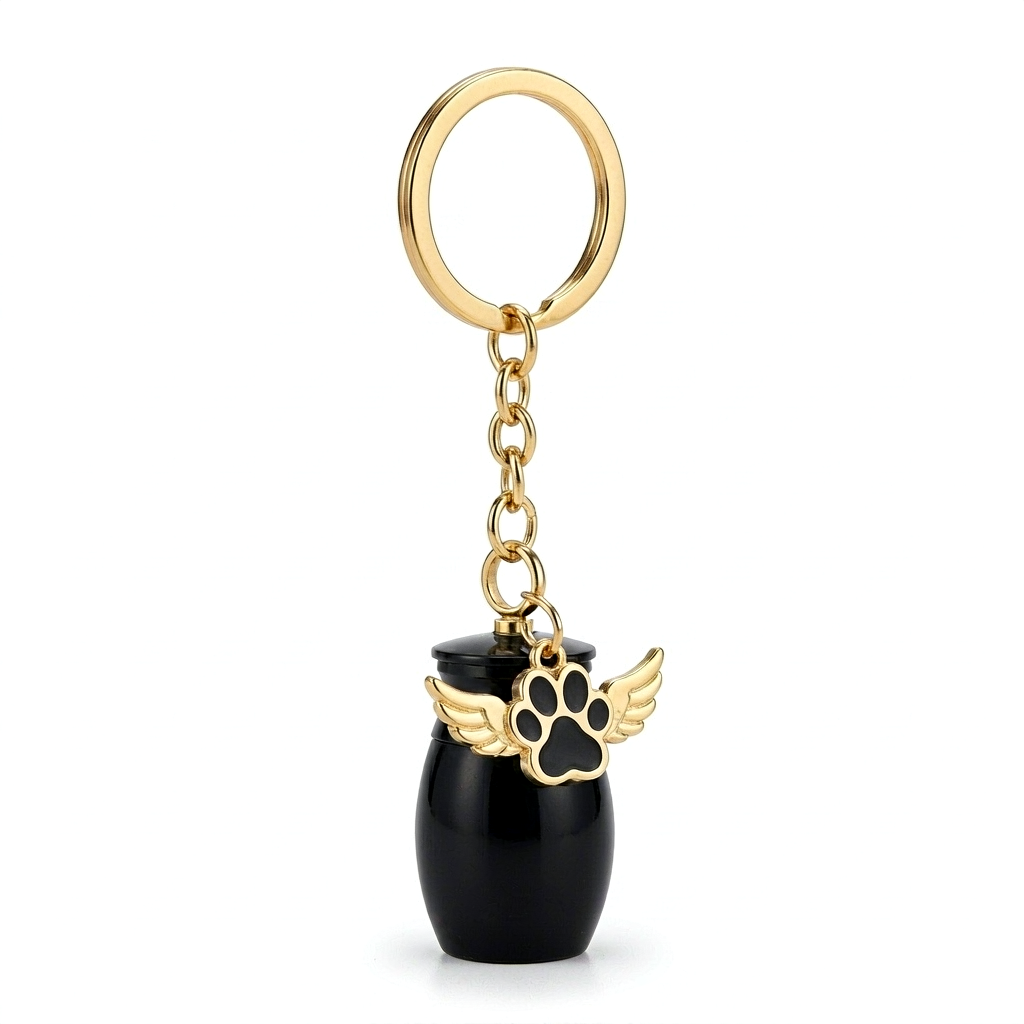
This is where small formats exist. Our 1.5 × 2.5 cm metal urn charm holds a genuine share and travels on a keyring, so someone who was not in the room still carries something. Our 3 × 4 cm rose-gold metal urn is the same idea at slightly larger scale, with the name and dates engraved on the surface.
Splitting is not a compromise. For a family with two people who both need to hold something, it is the most honest answer available.
Option Three: Not the Remains — an Object
Some people do not want an urn in the house at all, and there is nothing wrong with that. An overt urn can be hard to live with long-term, and a house should not have to accommodate grief on display permanently.
The objects that work in that situation use the photograph and the fur instead of the remains. A paw-print keyring with a small window holds a tuft of coat and nothing else — 6 × 9 cm including the keyring, worn rather than shelved. A leather photo keychain carries a color print on one face and an engraving on the reverse. A 3D resin portrait bust, 2.5 cm tall, is small enough for a desk and holds no ashes at all.
None of these hold ashes. All of them hold the animal. People who choose this route are not avoiding the decision; they have made it.
Option Four: Split Between Two Places
The most common shape, in practice: ashes in an urn at home, and a small object that travels with the person who was away. Nothing about this is contradictory, and it is worth knowing that both halves are ordered separately because they are made separately.
What to Do in the First Month, Roughly
Nothing here is a rule, and grief does not run to a schedule. But the general shape is useful.
Week one is the admin above. Get the weight, get the liner, get the paperwork signed.
Weeks two to four is when most people start to want something, and when the first impulse is usually to buy the wrong thing quickly. The useful pause here is to decide which of the four options above you are in, and to write down your pet’s weight in the same place you wrote the date.
Weeks four to eight is the practical window for commissioning. This is a made-to-order process, not a checkout. Production runs 7 to 10 business days after you approve the artwork — meaning after you have seen and confirmed the layout, not after you have paid. Then shipping is a flat $60 worldwide and transit is 15 to 25 days.
That total means roughly four to six weeks from approval to arrival. It is not a fast process and cannot be made into one, which is the single most common reason a keepsake misses the date someone was hoping it would land on.
If you missed an anniversary, do not order at midnight on the date. Order when you are ready and let it arrive when it arrives. Several of the things people regret most are the ones bought in a panic on a significant morning.
The Photograph, Specifically
Every product here is built from one photograph, so it deserves its own section.
Side-on light is better than front-on. Profile photographs give the clean outline that stained glass, sculpture and engraving all need. A flat front-facing image lit from the front has less edge definition.
Eye level, not above. Looking down at a pet flattens the muzzle. The photograph should be taken roughly where the animal’s head sits.
Ears and whiskers matter. These are the features that get smoothed out by editing software, and they are the features that make a likeness read as your specific animal rather than a generic pet portrait. Two cats of the same breed look identical without them.
One clear face beats five good ones. We ask for one photograph with the face unblocked. If you want to send more than one for reference, that is fine, but one is what gets made from.
Do not send a photo you have already cropped tightly. Leave a little around the head. A maker needs the ear outline and a bit of shoulder to read the proportions.
Filters flatten the wrong things. Beauty and portrait filters smooth exactly the fur direction and the small marks that carry resemblance. A straight, slightly overexposed phone photo is more usable than a polished one.
The Mistake That Costs the Most
It is not spending too much. It is buying before the weight is known.
Capacity decisions cascade. If you buy an attractive small vessel in week two and the ashes need more volume, you now have to either transfer and lose the vessel or buy a second thing and feel you have failed at a simple task. Neither is pleasant, and both are avoidable with a phone call.
The second-most-common expensive mistake is commissioning something that duplicates a photograph already on the wall. If you have five photographs of your dog in frames, a photo-based keepsake adds a sixth. The objects that add something new are the ones carrying material you cannot otherwise keep — the fur, the engraving, the sculpture in three dimensions, the light.
If They Are Buried Rather than Cremated
Not every family chooses cremation, and the keepsake question works differently.
If your pet is buried in a garden or a pet cemetery, you already have a location. That changes what an object is for. A marker at the plot does something nothing else can — it identifies the grave to somebody who visits it years later, which matters if the cemetery is a communal one shared with many animals.
A rectangular dark slate stone, 15 × 20 cm, engraved with a paw print, a name and life dates, serves that role. Natural layered slate is weather-resistant and ages without looking ruined, which is what you want from something standing outdoors permanently. It is also the object least suited to indoors; slate is heavy and cold and reads as a grave marker rather than a home object.
If your pet is buried at home, check what your local rules allow before ordering a marker. Some municipalities have specific requirements about burial on private property, and it is better to know before you commission something than after.
If your pet was cremated and you want a physical marker anyway — because a loved one who visits your garden has no grave to stand at — the same stone works, set into the ground or placed on a shelf. The function is the same either way.
What Actually Happens During Production
Worth knowing, because this is where most disappointment comes from and it is almost entirely about expectations of timing.
The photograph is prepared. Your image is cleaned up for reproduction — background removed or lightened, contrast balanced so the face reads at the size it will be printed or cut. This is preparation for making, not an alteration of what your pet looks like. If your photo has heavy filters already baked in, they stay; that is why the photo guidance matters.
You see a layout before anything is made. This is the approval step and it is genuinely the last checkpoint. Nothing is cut, fired, painted or engraved until you confirm how the name, the dates and the image sit together. If the composition is wrong, this is when it gets fixed.
Production runs 7 to 10 business days. For a resin portrait that is sculpting and curing. For stained glass it is cutting glass, foiling and soldering the lead lines. For a ceramic piece it is printing or engraving and, on the hand-painted urns, painting after firing. For a frame or shadow box it is assembly and wiring.
Shipping is a flat $60 worldwide. Transit is 15 to 25 days. The flat rate means the shipping cost is identical for a $39 pendant and a $649 urn.
So the realistic total from approval to arrival is four to six weeks. Anyone promising faster is either not making it to order, or is not telling you the approval step exists.
One consequence worth planning around: your order cannot ship until you have approved the artwork. A week of not noticing the approval email adds a week to the end date. This is the most common reason a made-to-order keepsake misses a date that was perfectly achievable.
Keeping It for Someone Else, or Keeping It Yourself
A recurring question after a loss is whether the person who is coping best should be the one who holds the memorial object. Usually the opposite happens — the person who functioned hardest in the first weeks is the one nobody checks on, and ends up being the one quietly holding everything.
Some practical distinctions that matter here.
Traveling objects work better than stationary ones for the person who was away. A keyring is worn and therefore seen. An urn on a shelf is visited occasionally. If someone was not in the room for the appointment and lives far away, an object that travels with them does more work than one that sits in someone else’s house.
Split the material rather than deciding who is more entitled to grief. Two metal urns, one each, at 3 × 4 cm, cost less than one large urn and serve two households. The capacity decision does not require all the remains in one place.
Ask what they want rather than assuming. A direct question — do you want something to hold, or something to look at — resolves in one exchange what several weeks of guessing will not.
Do not put all the decision-making on one person. If the person holding the ashes is also paying for everything, they are making every choice alone. Offering to take one decision off them is worth more than the object.
Four Things Worth Not Doing
Do not buy something in the first 48 hours. This is the period when the impulse is strongest and the information is worst. A $39 pendant bought on day two is not a mistake of money; it is a mistake of sequence.
Do not commission a portrait when the photograph is not good. Not because the maker cannot work with it, but because the result will disappoint and you will not know why. If your best photo is soft or filtered, use it for the object that does not depend on facial detail, and wait for a better frame for the piece that does.
Do not leave the dates off. The years are the part people most often omit and most glad they added. A name alone is half a sentence.
Do not expect to return it. Everything here is made to order and personalized. It cannot be resold or remade. This is the same property that makes it unable to be wrong twice, but it means the capacity decision has to come before the aesthetic one.
Common Questions
What should I keep from my pet? The unedited photograph, any fur you can find before it is vacuumed away, the collar and tag, and the weight and date. The weight is the one you cannot recover later — it is on the clinic record and determines what any urn needs to hold.
Is it normal to want more than one keepsake? Yes, and most households end up with two: something that holds the remains, and something that carries the image or the fur. People often choose the second one months later, once the first has found its place.
Can ashes be shared between households? They can be divided. Many families keep the larger portion at home and send a small amount to relatives who could not be present. Small metal urn charms exist specifically for a share rather than a full portion.
Do I have to display an urn? No. Some households find an overt urn hard to live with permanently, which is a reasonable preference rather than a failure of sentiment. The objects that carry a photograph or a tuft of fur instead of remains exist for exactly that situation.
How soon after a loss should I commission something? There is no required timing, and buying in the first 48 hours is the most common sequence mistake. What matters practically is having the weight and a usable photograph before you order, because capacity and image quality are the two things that cannot be fixed later.
Is a handmade memorial better than a mass-produced one? It depends on what you want. Mass-produced urns are cheaper and functional. What you are paying for in a made-to-order piece is the photograph, the engraving, the name and dates, and an object that was not pulled off a shelf.
Where This Actually Leaves You
Most people end up with more than one thing, and that is not indecision — it is the normal shape of it. Something that holds, and something that carries the image or the fur. Often the second is chosen months later, once the first has found its place.
If you take one practical thing from all of this: write down the weight now. It is on the clinic record, it takes eleven seconds, and it is the one input that everything else depends on and that nobody can supply for you later.
And if you are further along than this — the ashes are home and you are looking at five products trying to work out which one — the fastest route to a decision is deciding where each object would live. A shelf, your keys, a window with afternoon sun through it, a desk. The location settles it faster than any feature list will.
What It Costs, Plainly
Prices across our range run from a $39 seven-centimetre glass pendant through $49, $59 and $69 pieces, to $89 for a lit shadow box or a backlit frame, $189 for a resin portrait bust, and $499 to $649 for the hand-painted large ceramic urn.
Shipping is a flat $60 worldwide regardless of the item. Transit is 15 to 25 days. The shipping cost is identical for a $39 pendant and a $649 urn, which is worth knowing if you are splitting an order.
We will be direct about why the range is so wide. A $39 pendant is a small hand-cut glass piece; the material cost is trivial and the work is the design. A $499 urn is painted by hand, one at a time, after firing — that labor is the price, and it is also why the sizes are fixed rather than made to whatever volume you need, because each size is a mold.
Every item is made for one animal, from one photograph. None of them exists before you order it, which is also why none of them can be returned afterwards.
If You Are Supporting Someone Else
A friend who has just lost a pet often receives well-meant things that do not land. The most common error is a plant, which requires care at exactly the moment they have least capacity for care. The second most common is a framed photograph of their own pet, which adds a portrait to a wall they already have on it.
What tends to work is something that carries the specific animal’s name, and something that does not require maintenance in the first month. If they have said yes to a keepsake, the decision has already been made and your job is mostly the photograph.
If they have not, do not push. The first six weeks are not the moment to introduce an object into the house.
A Short Version
Get the weight. Write down the date. Keep the unedited photograph and any fur you can find. Decide whether you want the remains, an object, or both — there is no wrong answer. Choose from the table above, step up a size if the weight is near the top of a band. Commission it, approve the artwork, and allow four to six weeks.
If you have already done some of this and are now looking at four products and cannot choose between them, that is the most common place to be stuck. Look at where each one would actually live. If the answer is a shelf, an urn. If the answer is your keys, a keychain. If the answer is a window with afternoon sun through it, stained glass. The location decides faster than the features do.
The Pieces Referred to Here
- Pet Urn Keychain – Tiny Metal Ash Charm with Engraved Paw Print
- Paw Print Hair Keyring – Leather Keepsake with Window for Pet Fur
- Custom Pet Memorial Urn – Compact Black Ceramic Ash Urn with Photo, Name & Dates
- Pet Memorial Garden Stone – Slate Headstone with Paw Print, Name & Dates
- Miniature Pet Ashes Urn – Rose Gold Metal Keepsake with Engraved Paw & Dates
Each piece is made to order from one photograph, so the choice between them is where it sits, what it is made of, and whether it holds anything.
Pieces Mentioned Here
Every piece is made to order from your own photograph, so no two are the same.
Questions People Ask
- What should I keep after my pet dies?
- The unedited photograph, any fur you can find before it is vacuumed away, the collar and tag, and the weight and date. The weight is the one you cannot recover later, because it determines what any urn needs to hold.
- How much should a pet urn hold?
- Ashes run roughly three to five percent of body weight. The industry planning figure is about one pound of pet per cubic inch of capacity, or 35 mL per kilogram, and you should step up a size for the sealed liner and for aquamation, which returns about twenty percent more.
- Can ashes be split between family members?
- Yes. Many families keep the main portion in an urn at home and send a small share to relatives who could not be present. Small metal urn charms exist for exactly that, at 1.5 cm and 3 cm.
- Do I have to display an urn?
- No. Some households find an overt urn hard to live with permanently, which is a reasonable preference rather than a failure of sentiment. Objects carrying a photograph or a tuft of fur instead of remains exist for that situation.
- How soon after a loss should I commission a memorial?
- There is no required timing, and buying in the first forty-eight hours is the most common sequence mistake. What matters practically is having the weight and a usable photograph first, because capacity and image quality are the two things that cannot be fixed later.