Which Pet Urn Is Right for You? A Plain Comparison of Sizes and Prices
Choosing a pet urn comes down to two matches: internal volume against the weight of the animal you lost, and shape against where the urn will actually live. The category has filled up with objects that look broadly similar and hold very different amounts, and most product pages make you work out the difference yourself. This guide works through the four pet urns we make, smallest first, so you can match one to the animal you lost without guessing.
Every dimension and price below comes straight from what the workshop specifies. Where the workshop does not publish a figure, this guide says so rather than filling the gap with an estimate. That is deliberate: an urn is a container, and a container you sized wrongly cannot be exchanged once it has been engraved.
Start with the Weight, Not the Size on the Box
This is where most people go wrong, including people who have done this before.
Nobody buys an urn for a generic pet. You are buying it for one specific animal, and that animal’s size determines the volume you need. A 3 cm urn and a 6 cm urn differ by roughly four times the internal volume, but the number that matters is not the width printed on the page — it is how much your pet weighed at the end.
A cat, a Chihuahua, or a very young animal leaves a small amount behind. A Labrador leaves several liters. There is no rule of thumb that works reliably across breeds, which is why each of our product pages carries a capacity line, and why you should read it before choosing anything else.
Two things to establish before you pick anything: the weight your pet was at the end, and the capacity listed on the product page. Get those two straight and the choice becomes straightforward. Skip them and you risk an urn that cannot hold what it needs to.
If you do not know the weight, a veterinary clinic that handled your pet can tell you. It is a short question and nobody will find it strange — they are asked it regularly.
The Arithmetic That Settles It
Before any of the four products matters, there is a calculation worth doing. It is the part most guides skip, and skipping it is why people end up with an urn that is either too small or absurdly large.
The cremation industry uses a consistent conversion: roughly one pound of your pet’s body weight produces about one cubic inch of cremated remains. In metric, that is close to 35 millilitres of urn capacity per kilogram of body weight.
This works because of what cremation actually removes. Organs, muscle and all fluid burn off entirely; what is left is bone, ground to a sand-like powder. The result is only three to five percent of your pet’s living weight, which is why the returned container feels so much lighter than the animal you are grieving. A 34 kg Labrador yields something in the region of 1.4 to 2.3 kg of ash — and that fills a container far smaller than you would imagine.
You will also see crematoriums quote the industry-wide planning figure of one liter of urn capacity per 450 g of body weight, which is deliberately generous. Both rules land in the same place, and either one gives you a defensible size.
| Your pet’s weight | Approx. ash volume | Sensible minimum capacity |
|---|---|---|
| 2 kg | 60–70 mL | 100 mL |
| 5 kg cat | 150–175 mL | 250 mL |
| 10 kg | 300–350 mL | 450 mL |
| 20 kg | 600–700 mL | 850 mL |
| 30 kg | 900 mL–1.05 L | 1.2 L |
| 40 kg | 1.2–1.4 L | 1.6 L |
| 50 kg | 1.5–1.75 L | 2.0 L |
Three things worth knowing about these figures:
They depend on bone structure, not just weight. A lean, large-framed dog produces more ash than a heavier dog with a finer frame. This is the single biggest reason two animals of identical weight can need different urns.
Aquamation returns noticeably more. Where alkaline hydrolysis is available instead of flame cremation, expect roughly 20 percent more volume. Plan for a larger urn if that is the method your clinic uses.
The bag matters. Ashes come back sealed inside a plastic liner. The liner occupies space, and its shape can be awkward to fit through a narrow opening. This is a good reason to step up a size rather than calculate to the millilitre — an urn does not need to be full.
A useful check: if the clinic gives you the weight of the returned ashes in grams rather than a volume, divide that figure by roughly 16 to get the cubic inches you need. A 480 g return needs about 30 cubic inches.
One caveat that catches people out. All of the above refers to interior usable volume, not the dimensions printed on the outside. A vessel 6 cm across and 8 cm tall does not hold anything close to the volume those numbers suggest once wall thickness, the base and the lid seat are accounted for. We publish capacity rather than relying on exterior measurements for exactly this reason.
The Four Urns, Smallest to Largest
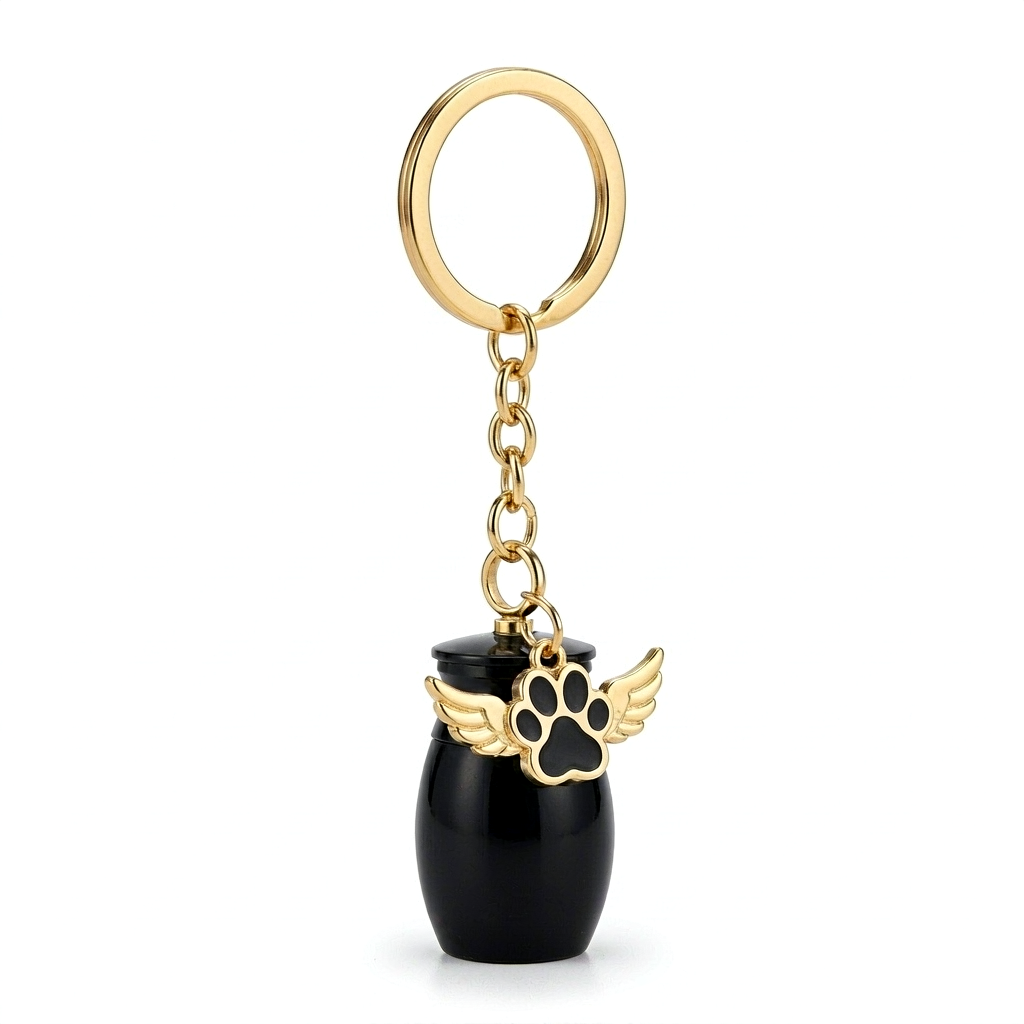
Pet Urn Keychain — $49
The smallest thing we make, and the one most often bought for a reason other than capacity.
The urn itself measures 1.5 cm wide by 2.5 cm tall. It is gold-tone metal with an engraved winged paw print, hung from a split keyring by a short chain.
Be clear-eyed about what this holds: a very small amount. It is a keepsake, not a container for everything. People buy it for one of two reasons. Either they want something to carry daily, and a keyring does that better than a shelf ornament. Or they are splitting ashes between family members and this goes to the person who could not be at the cremation — a sibling abroad, a child who was too young, a partner who could not face the room.
That second reason comes up more often than the marketing suggests. It is not a lesser purchase. It is often the one that means most.
- Urn size: 1.5 cm wide × 2.5 cm tall
- Material: gold-tone metal
- Personalization: engraved winged paw print
- Hardware: split keyring with short chain link
If you want the urn to hold everything, keep reading. If you want something to carry, this is the one.
Miniature Pet Ashes Urn — $59
Three centimetres wide, four centimetres tall. This one is engraved rather than printed, which is the detail that decides whether it is worth choosing: the winged paw, the name and the life dates are cut into a rose-gold tone metal with a satin finish, so they will not wear off the way a surface print can.
This piece can be ordered two ways — plain engraving, or engraving with an added color print on the lid. The printed version puts a small image of your pet on the lid; the plain version stays purely typographic. Both carry the engraving. This is worth thinking about if you have a strong feeling about which you would rather live with on a shelf.
- Dimensions: 3 cm wide × 4 cm tall
- Material: rose-gold tone metal, satin finish
- Personalization: engraved winged paw print, name and life dates
- Finish: polished and brushed metal tones available
Four centimetres is still a small object. It suits a cat, a small terrier, or a portion rather than the whole.
Compact Ceramic Memorial Urn — $69
Six centimetres wide, eight centimetres tall. This is the first option on this list that holds a meaningful amount without becoming furniture, and it is where most people end up.
It is matte-finish ceramic with a fitted lid. The photograph is printed into the surface, with the name and life dates in engraved-style lettering beneath it.
The matte glaze is a deliberate choice rather than a default. It reads as a quiet object instead of a shiny ornament, it does not show fingerprints the way a gloss finish does, and it sits better in a room where a photograph of the same animal is on the wall. Gloss competes with the picture. Matte does not.
- Dimensions: 6 cm wide × 8 cm tall
- Material: matte-finish ceramic
- Personalization: printed photo portrait, engraved-style name and life dates
- Finishing: matte black; other colorways on request
At eight centimetres it sits comfortably on a shelf, a mantel or a cabinet without taking the space over. For most medium dogs and for cats, this is the answer.
Hand-Painted Ceramic Urn — $499 to $649
The full-size option, and the only one of the four with a published capacity range. Ours comes in four sizes, from 500 ml to 1700 ml, which is the range that covers a large dog.
Two things separate it from everything else on this list. It is hand-painted rather than printed, and it is airtight and moisture-proof — which is what makes it suitable for burial as well as for display.
That hand painting is where the price difference comes from. It is not margin. A printed urn is produced in a run; a hand-painted one is painted by a person, one at a time. The price band of $499 to $649 reflects that, and it is also why the lead time runs longer than the printed options.
- Sizes: 500 ml / 1000 ml / 1500 ml / 1700 ml
- Material: ceramic, hand-painted
- Seal: airtight, moisture-proof
- Suitable for: burial or display
This is the one you choose for a Labrador, a Mastiff, or any animal where volume simply is not in question. If you are also planning a graveside placement rather than an indoor shelf, this is the only urn here designed for it.
Metal, Ceramic, or Both — What the Material Actually Changes
Once the capacity question is settled, material is the second decision. It matters less than people expect, and for a different reason than they expect.
Ceramic is what most urns are, and it is the right default for a few practical reasons. It is completely inert, so nothing leaks or degrades over decades. It takes an engraved name and a printed photograph cleanly. It is heavy enough to feel like an object rather than a trinket, which some people find important and others find excessive. Our compact urn uses a matte glaze rather than a gloss, and the compact large urn is airtight and moisture-proof for burial use.
Metal is smaller than you would expect for its capacity. A 3 cm urn and a 1.5 cm urn are both metal, because metal walls are thin. Metal also takes engraving exceptionally well — the lettering is cut into it rather than printed on, which is why the name and dates on both of our metal urns will outlast any surface print.
Where the two genuinely differ is in how they age. Ceramic is inert and unchanging. A satin metal finish will develop a faint patina over years if it is handled. Neither is better. Some people find a piece that shows handling to be a nicer object ten years on; others want something that looks the same as the day it arrived.
The photograph question. Our ceramic compact urn prints your pet’s image into the surface; the metal options engrave type only, with the small printed image available on the mini urn’s lid. This is not a quality hierarchy. A printed portrait is more literal and more moving for some people. An engraved name and dates, with no image, is quieter and works better in a room that is already full of photographs.
Where the Urn Ends up Matters More than Most People Expect
This is the part of the decision that nobody warns you about, and it is worth ten minutes of thought before you order.
Think about where your pet actually spent their time. A dog who slept beside the sofa, or waited by the kitchen, or lay in a specific patch of afternoon sun — placing the urn near that spot usually feels more right than building a separate memorial arrangement. The association does more work than any display convention.
A cat has a similar pattern: a windowsill, the warmest chair, the end of the bed. Those places already mean something. Putting the urn there turns an ordinary piece of furniture into a place where someone is remembered.
This matters because of what actually happens in most households. A dedicated memorial shelf is beautiful on the day it is arranged and often awkward within a year, because it interrupts the room. An urn beside the photograph already on the wall, or on the console where the keys go, stays part of the house without asking for attention.
If ashes are to be shared, the practical question is who physically carries them. A keyring urn exists for exactly this — it goes on the keys of the person who was not present.
The Container You Are Given, and Whether to Transfer
Worth knowing, because it affects your choice. Every cremation includes a basic container — usually a scatter tube, a plain wooden casket or a polymer box chosen by the crematorium rather than by you. It is functional and dignified, but it is not made to be looked at for years, and most families do not want it on a shelf.
The alternative is to buy a urn separately and transfer the ashes. This is straightforward: the remains come back sealed inside a plastic liner, so you are not handling anything directly. Transfer means cutting the liner open above the new urn and pouring.
If you plan to transfer, choose based on capacity with the liner’s size in mind. This is the other reason to step up rather than calculate to the exact millilitre.
Three Questions People Ask, Answered Without Hedging
Does the urn have to say “pet” or show a paw print?
No. Paw prints and engraved wording are entirely appropriate for many families and wrong for others. A plain ceramic form in a soft neutral color, sitting quietly on a console next to a framed photograph, reads as remembrance without announcing itself. Some households find an overt urn uncomfortable to live with, and that is a perfectly reasonable thing to want.
Our four urns cover both ends of this. The mini urn and the keychain both carry an engraved winged paw, which is decorative and traditional. The ceramic compact and the hand-painted large urn lead with the photograph and the name, which is more restrained.
Should I buy the urn before or after the cremation?
After, in practical terms — you want the volume to match what actually comes back, and for most people the container arrives with the ashes. But ordering the urn before the service is not a problem, and it has one real advantage: everything gets made in parallel rather than sequentially, so it is ready sooner. If you are working to a date, that matters.
Is it cheaper to buy from the crematorium?
Usually, yes, and we will not pretend otherwise. The crematorium’s own upgrade urns are cheaper because there is no personalization in the price. What you pay for with an independently bought urn is the photograph, the engraving, the name and the dates — and an object made for one animal rather than pulled from a range.
Whether that is worth it is not a question we can answer for you. Plenty of people place a simple container on a shelf, put the photograph beside it, and feel that is a complete tribute. Others want the object itself to carry the animal’s face. Both are reasonable.
Which One, in One Table
| Your situation | The urn | Price |
|---|---|---|
| A cat, or a very small dog | Miniature Pet Ashes Urn | $59 |
| You want something to carry daily | Pet Urn Keychain | $49 |
| Splitting ashes between family | Keychain for whoever cannot carry a larger urn, plus an urn for the rest | $49 + $59 |
| A medium dog, most cats | Compact Ceramic Memorial Urn | $69 |
| A large dog | Hand-Painted Ceramic Urn | $499–$649 |
| Graveside burial rather than a shelf | Hand-Painted Ceramic Urn (airtight, moisture-proof) | $499–$649 |
Two Questions Worth Asking Before You Order
Can I Change My Mind About the Size?
Not once it is made. Every urn is produced to order from your photograph and carries the name and the dates, so it cannot be resold and cannot be remade. This is where the difference from an off-the-shelf object matters most: a generic urn can be returned, and a personalized one cannot. Get the size right the first time.
What Happens If I Choose Wrong?
Contact us before production starts. Every order goes through an artwork approval step, and that is the window in which a size question can still be caught and changed. After approval, it is too late — not because we will not help, but because the object already exists.
This is also why we ask for the photograph before anything else. The size decision and the artwork decision happen in the same conversation, which is why they need to happen together.
The Question We Get Most Often
Is a small urn disrespectful?
No. Nothing about a 4 cm object is a lesser tribute to an animal. What makes a memorial meaningful is that it names a specific animal and a specific set of years — which every one of these does, and which a generic urn with no engraving never will.
The people who choose the smallest option are often the ones who carry their pet most visibly. A keyring goes out with you every day. That is not a compromise; it is a different way of keeping them present.
What the Money Is Actually Going On
The price gap between a $49 keychain and a $499 hand-painted urn is large enough that people assume the difference is profit. It mostly is not, and understanding why makes the choice easier.
At the small end, a 1.5 cm metal charm is a stamped and engraved object. The material cost is a fraction of a dollar; the photograph processing and the engraving setup are the cost. Nothing is hand-painted.
At the large end, a hand-painted ceramic urn is painted by a person, one at a time, after firing. The labor is the price. This is also why the lead time is longer and why the sizes are fixed rather than made to whatever volume you need — each size is a mold, and a mold is a fixed thing.
So the useful question is not “why is one more expensive” but “which of these is the object I want to look at every day.” A $59 engraved metal urn and a $69 printed ceramic urn are close in price and completely different objects. A $499 hand-painted urn is not a better version of the $69 one; it is a different object that happens to hold more.
Five Mistakes Worth Avoiding
Buying on price rather than capacity. The cheapest urn that holds everything is the right purchase. The most expensive urn is not automatically the most respectful choice.
Ordering to a date rather than to arrive. Production takes 7 to 10 business days after approval, and transit is 15 to 25 days. If you order on the anniversary, you have missed it.
Using a heavily filtered photograph. Flattening and heavy filters remove the fur detail the maker works from. The result is a portrait that looks slightly wrong and you cannot identify why. A plain, well-lit phone photo is better.
Leaving off the dates. The years are the part people are most glad they added and most often omit. Name alone is half a sentence.
Expecting to return it. Every urn is made to order and engraved. It cannot be resold or remade. This is the same reason it cannot be wrong twice — but it means the capacity decision has to come first.
A Short Version, If You Have Read None of the Above
Find your pet’s weight. Look up the volume. Choose the smallest urn on this list that comfortably holds it, and if the weight is near the top of a band, step up one size. Then choose between metal and ceramic based on whether you want engraving or a printed photograph, and decide where it will sit before you order rather than after.
Everything else — the material, the size in centimetres, the color — matters far less than those two decisions.
What We Need from You
One clear, well-lit photograph. Flattened images and heavy filters destroy the fur detail the maker works from, which is why a straight phone photo — daylight, at the animal’s eye level, face unblocked — usually beats an edited one. We would rather work from an ordinary photograph than an artistic one.
The name and the dates. Both, including the year of passing. The dates are the part people are most glad they added, and the part they most often leave off.
A decision on engraved or printed. Both are legitimate; they produce different objects and different price points.
Common Questions
How do I know my pet’s weight if they have already gone? Most veterinary clinics can tell you from their records. The weight is recorded at the last visit, and it is the same figure the crematorium will use for their capacity guidance.
Can ashes be split between urns? Yes, and this is more common than it used to be. Some families keep the larger portion in an urn and send a small amount to relatives who could not be present. Our smallest urn exists for exactly that.
Is a sealed liner a problem for a small urn? It can be. The liner occupies volume and its shape varies, which is why we recommend stepping up a size rather than calculating to the exact millilitre. If you know your liner’s dimensions, that is the figure to work from.
How long does an engraved name last? Engraving is cut into the surface, so it does not wear off the way a print does. A satin metal finish may develop a patina over years of handling; the lettering stays legible underneath it.
Do you ship urns internationally? Yes. Shipping is a flat $60 worldwide regardless of the urn, and transit runs 15 to 25 days. Transit is the same for a $49 charm and a $649 urn, which is worth knowing if you are splitting an order.
Timing, Plainly
Production takes 7 to 10 business days after you approve the artwork. Shipping is a flat $60 worldwide and runs 15 to 25 days in transit.
Add those together and you are looking at roughly five to six weeks from order to arrival for the printed options, and longer for the hand-painted urn. If you are working toward a date — a first anniversary, a Christmas, a service — order to arrive rather than ordering on the day.
Every urn on this list is made for one animal, from one photograph. None of them exists before you order it, which is also why none of them can be returned after it is made.
If you are still unsure, the fastest route to a decision is this: find the weight, look up the volume in the table above, and read only the sections for the two urns that bracket it. The difference between those two will tell you which one you actually want — and if that still leaves you genuinely torn, send us the weight and the animal’s breed and we will tell you which one we would choose.
The Urns Compared Here
Every urn above is made to order from your photograph, so capacity, material and engraving are the only things to choose between.
Pieces Mentioned Here
Every piece is made to order from your own photograph, so no two are the same.
Questions People Ask
- How do I know which urn size I need?
- Work from your pet's weight at the end. Ashes run roughly three to five percent of body weight, and the industry planning figure is about one pound of pet per cubic inch of urn capacity, or 35 mL per kilogram. A clinic can give you the weight if you do not have it to hand.
- Can ashes be split between different urns?
- Yes. Many families keep the larger portion in an urn and send a small amount to relatives who could not be present. Our smallest urn exists for exactly that.
- Can I return or exchange an urn after ordering?
- Not once it has been made. Every urn is produced to order from your photograph and carries the name and dates, so it cannot be resold or remade. This is also why the capacity decision has to be made first.
- Do I need a professional photograph?
- No. A phone photo in daylight, taken at your pet's eye level with the face unblocked, gives the maker more to work from than a heavily edited or flattened image.
- How long does a custom urn take to arrive?
- Production runs 7 to 10 business days after you approve the artwork, then shipping is a flat $60 worldwide and takes 15 to 25 days in transit.