World Pet Memorial Day: How Families on Four Continents Mark It
World Pet Memorial Day falls on the second Tuesday of June — 8 June in 2027 — and it has no central body, no fixed ritual, and no official list of what anyone is supposed to do. That is exactly what makes it usable: families in more than thirty countries mark it however they already remember, from a candle at dusk to a photograph on the mantel to a walk along a familiar route.
That lack of an official ritual is the interesting part. The day works because people invent their own, and the customs that have emerged differ sharply between continents — in what is remembered, where it happens, who participates, and whether anything physical is made at all.
This guide covers how the day is actually observed, and what kind of keepsake suits a communal occasion rather than a private one.
The Date and What It Is Not
| World Pet Memorial Day | Second Tuesday of June — 8 June in 2026, and the same weekday in 2027 |
| Nature of the observance | Local, self-organized, no governing body |
| What it is not | A funding day, a funeral service, or a commercial event |
It is worth being clear about one thing first: this is not a day on which anything is sold. There is no official product, no commemorative merchandise, and no ceremony that has to be attended. It is a date that some people mark quietly and other people ignore, and both are ordinary.
The distinct observance in the United States is National Pet Memorial Day, the second Sunday in September. That is a separate day and it exists because a September date seemed more appropriate than a June one. People who mark both are not confused about it.
Why June, and Why a Tuesday
The second Tuesday of June is late enough to be past the anniversary of most recent losses, and early enough to be before the summer holidays that disperse people. A Tuesday is a working day, which suits an observance that happens quietly at a desk rather than at a gathering.
Neither choice has a deep logic. What matters practically is that the date moves each year, so nothing can be ordered specifically for it in advance — a memorial object made for this day in one year will not align with the day in the next.
How It Is Observed in Four Places
The United Kingdom and Ireland
The British version is the quietest and the most domestic. The custom is an evening: light a candle, put a photograph somewhere visible, and sit with it. Some households put the photograph on a windowsill with a flower. Others simply mention the animal out loud.
What distinguishes it is that it is done alone or in twos, not as a gathering. A person at a desk on a Tuesday evening is not looking for company; they are marking something they would otherwise have carried silently for a year.
Objects that fit this version are small and personal rather than communal: something on a windowsill, something carried, something that goes back in a drawer.
North America
The American observance has a stronger public dimension. The National Pet Memorial Day in September in particular tends to involve something collective — a gathering at a park, candles placed somewhere visible, photographs shared on social media in the same way people share photographs of living pets.
The objects that appear are frequently public-facing: something placed outside, something carried to a gathering, something visible to other people rather than to one household.
If you are marking this day in North America and you want a physical object, the useful criteria are different from the British version. Visibility matters more than intimacy.
Continental Europe
In parts of Europe the practice is more religious-adjacent than either of the above. Some households treat the day like All Souls’ Day applied to animals: flowers placed, a light lit, a moment observed at home with no particular object.
What is common across Europe is the absence of a commercial dimension. Very few European households buy anything for this day, and the ones that do tend to be small: a candle, a card, a photograph in a frame that is not new.
That is a real difference from the American version, and it means a European-marked household is unlikely to want a large display object for the occasion.
Australia and New Zealand
Southern-hemisphere households mark it at the same calendar date — the second Tuesday of June, which is midwinter for them. A June candle is a much more atmospheric object in Melbourne or Auckland than it is in Manchester.
The custom is closest to the British one, quiet and domestic, with the seasonal inversion adding something. A lit object in a dark winter evening carries more weight there than it does in a summer one.
What Actually Gets Made
Across all four versions, the objects people end up with fall into a small number of categories.
Photographs, but not new ones. Most households already have photographs. The day tends to pull an existing photograph out of a drawer and display it, rather than prompt a commission.
Something placed outdoors or at a window. A candle, a small stone, a photograph in a frame. Visibility is the common factor.
Something made by hand rather than bought. A great many people who mark this day make something — a drawing, a piece of textile work, a patchwork square. The making is part of the observance, not a preliminary to it.
Something small and carried, for people who were not present. Less common, and more likely to be ordered than made, because it is the one object that cannot be handmade by the person mourning.
That last category is where made-to-order pieces fit, and it is worth being honest about where they sit: this day is not well served by a gift shop, and most of what people do on it is not purchase-shaped.
Which Keepsakes Suit a Communal Day of Remembrance
Given the above, the objects that work for this occasion are the ones that either travel or stand outside. Four from the range.
A Slate Garden Stone — for Outdoors
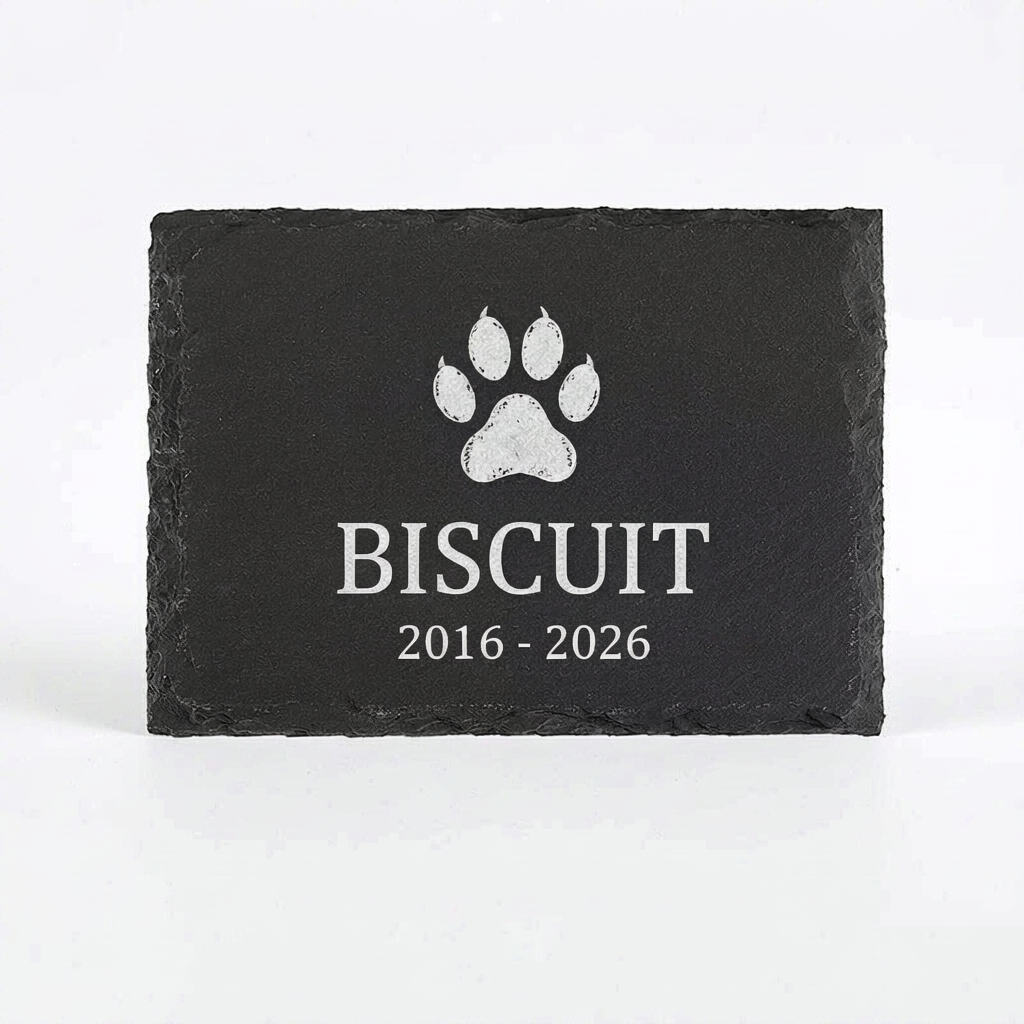
Rectangular 15 × 20 cm, natural dark slate, engraved with a paw print, the name and the life dates. $59.
This is the clearest match. A memorial stone is for a place — a garden, a plot, a shelf — and this day is about marking a place as much as a person. Slate weathers without looking ruined, which is exactly what you want from something standing outside permanently.
It is also the one object in the range with no use beyond marking, which makes it honest for this occasion. You are not buying a dish that happens to hold a photograph.
A Compact Ceramic Urn — for a Household Observing Quietly
6 cm wide by 8 cm, matte-finish ceramic, printed photographic portrait with engraved-style name and dates. $69.
For the British and European version of the observance — one person, an evening, a photograph on a windowsill — this is the object that matches. It is small, it is opaque, it is not decorative, and it can sit somewhere specific without announcing itself.
The matte finish is deliberate for this use: it does not glare under a candle or a low lamp, which a gloss surface would.
A Paw-Print Hair Keyring — for Carrying
6 cm wide by 9 cm tall including the keyring, tan suede, transparent round window holding a tuft of fur, engraved photograph on the reverse. $49.
For households where not everyone was present for the loss, this is the object that works. It is carried rather than displayed, so it travels to work, to school, to another city. It holds fur rather than a face, which means it can be given in the first weeks without requiring anyone to look at a portrait daily.
A Small Metal Urn Charm — for a Share
1.5 × 2.5 cm, gold-tone metal, split keyring, engraved with a winged paw print. $49.
Where the material needs to be divided among people in different places, this is the object. It is small enough to be genuinely portable and it holds a real share rather than a symbolic one.
Why This Day Is Worth Taking Seriously as a Business Occasion
This is the honest question for a shop that sells memorial products, and the answer is uncomfortable.
The search volume is small. World Pet Memorial Day is a fraction of the traffic that Mother’s Day or Christmas gets, and a fraction of what queries like “what to write in a pet sympathy card” attract.
The intent is not commercial. People searching for this day are looking for the date and for what people do. They are not shopping, and a page that tries to convert them reads as tone-deaf.
The people who mark it are often not shopping for anything. The day is observed by people who have already made their arrangements and are simply noting a date.
But the occasion is real, and the search is a genuine one. Somebody Googling this at a desk on a Tuesday in June is having a specific kind of quiet moment. That is worth writing about well, which is what this page attempts.
Which means the right thing for a shop to do here is inform rather than sell. Publish the date accurately, describe what people actually do without inventing a ritual that does not exist, and offer objects only where an object genuinely serves. That is a smaller commercial outcome than a seasonal campaign, and it is the honest one.
There is also a timing problem worth acknowledging. Because the date is the second Tuesday of June and most people do not know it, the useful publication window is narrow: early June catches people who are already looking, and a post in May that announces the date reaches the people who would not have searched. Both are legitimate, and neither is a large audience.
What the Four Versions Have in Common
Worth drawing out, because the differences above can obscure the thing that actually makes this an observance rather than a date.
It is annual and short. One day, once a year, a few minutes or an evening. Nobody spends six weeks on it. The scale is deliberately small, which is why a made-to-order object over four to six weeks is a poor structural fit.
It is not tied to the death. Unlike a birthday or an anniversary, World Pet Memorial Day is not the date anything happened. It is a general day for remembering pets that have died, whoever and whenever. That removes the need for a specific date and also removes the reason to mark a photograph of a specific moment.
It is private for most people. Even the more public American version is mostly people posting individually rather than gathering. The image of a congregation is not what this is.
It involves almost no objects. A candle, a photograph, sometimes a flower. The whole practice could be performed with nothing bought at all.
These four facts are why this article spends most of its length on observance and only a section on products. That is the accurate proportion, and a page that inverted it would be describing something that does not exist.
If You Want to Mark It Yourself
Four things, in the order they work.
Light something at the time of day you remember them at. A candle at the hour they were found, or the hour you last saw them well, is more specific and more accurate than a candle at a fixed hour.
Say the name out loud. This sounds trivial and is not. Most households that observe this day do exactly one thing beyond the candle, and it is usually the name.
Put the photograph somewhere visible for the evening and then put it back. Not on permanent display — visible for the day and then returned to a drawer. That is closer to what people actually do than any permanent arrangement.
Do not buy anything for yourself. This one is difficult and it is the reason people end up with objects they did not choose. The day is not an occasion for self-purchase, and a keepsake bought in that mood tends to sit in a cupboard.
If you want a physical marker of the day rather than of the animal, and you do not already own an urn, that is a legitimate reason to order one — but it is a decision made on an ordinary day, not on the Tuesday.
When More than One Pet Is Gone
Commoner than a single-pet household, and it changes the object question rather than the observance.
Remembering several animals on one day is harder, not easier, because a single candle and a single photograph cannot hold five animals at once. Households in this position tend to do one of three things: put out several candles, put out one photograph and say all the names, or mark the most recent animal and let the others have their own separate dates.
None of these is wrong and there is no convention to follow, because the day has no convention.
For objects, a household with several animals is a strong case for small carried pieces rather than one large one. A 1.5 cm urn charm per animal, or hair keyrings where fur was collected, are objects that coexist rather than compete. Five large pieces on five shelves is a display project; five small pieces on five keyrings is a set of relationships.
Where the animals died together — a litter, a bonded pair, several cats from one household — a single photograph containing several of them is legitimate and often better than choosing one. Nothing in the process requires a single subject, though the objects that reproduce detail best do.
A Short Version
World Pet Memorial Day is the second Tuesday of June. It has no governing body, no fixed ritual and no official product. In the UK and Ireland it is a quiet evening with a candle; in the United States the better-known version is National Pet Memorial Day on the second Sunday of September and is more public in character; in continental Europe it resembles All Souls’ Day applied to animals; in Australia and New Zealand it is the same quiet practice with a midwinter candle.
Most of it involves nothing bought. The three cases where an object genuinely serves are a marker for a plot, a share for a relative in another place, and something a person can carry.
And if you are in the United States and want a physical object tied to a date, September is far more workable than June, because the four-to-six-week lead time does not have to fight the summer.
The day itself is worth knowing about for a reason that has nothing to do with this shop: somebody you know may keep it quietly, and they will not mention it.
The National Pet Memorial Day in September
Worth a short section, because it is the better-known version in the United States and the two get confused.
The date is the second Sunday in September. In 2027 that is 12 September.
It is a separate observance with a longer history in the US, connected to veterinary practice and to the idea of a day set aside for animals rather than people.
It is more public in character. Candles placed somewhere visible, photographs shared, occasionally a gathering. The September date works because it is not attached to any existing holiday, which gives it its own character.
The practical implication for ordering is better than June. September is after the summer, so an object commissioned in June or July arrives in time. Working backwards from 12 September with four to six weeks of lead time means an approval deadline around the end of July — a comfortable window rather than the tight one June imposes.
If you are in the United States and want to mark something with a physical object, the September date is more workable than the June one.
Common Questions, Part Two
Are World Pet Memorial Day and National Pet Memorial Day the same? No. World Pet Memorial Day is the second Tuesday of June and has no governing body. National Pet Memorial Day is the second Sunday in September and is the better-established United States observance. They are roughly three months apart and people who mark both are not confused.
Why is it on a Tuesday? Because it has always been on a weekday, which suits an observance that happens quietly at a desk or in the evening rather than at a gathering. There is no deeper logic to it.
Do people gather for it? Mostly not. The public version in the United States involves candles placed visibly and photographs shared, and some localities hold informal gatherings, but the majority of observance is individual or household.
Is it a good time to commission a memorial piece? June is tight, because the date moves and the lead time is four to six weeks. The September United States observance is more workable because it falls outside the summer. Either way, deciding in advance is better than deciding on the day.
Should I tell someone else about this day? Only if they have a pet that died and you do not know how they mark it. It is not a day to introduce into a conversation with somebody who has not mentioned their loss, and it is not a thing to organize for another person.
Is this article selling anything? It names four objects because the question of whether an object serves this occasion comes up, and the honest answer is only in three cases: a marker for a plot, a share for a distant relative, or something carried. Everything else about this day is better served by a candle and an evening.
What to Avoid for This Occasion
Anything described as commemorative. Objects that exist to mark a date rather than to remember an animal read as merchandise, and this day is not one where that lands.
A new framed photograph. Most households have the photographs already. A commissioned portrait for a day that most people mark quietly is likely to be one object too many.
Anything that requires a decision. This day is observed by people who are not necessarily in a good state to make decisions about furniture.
A gift for someone else. This is an observance, not an occasion for exchanging presents. If someone in your household marks it and you do not, leaving them alone with it is kinder than including them in a gesture that is not for them.
Working out How a Household Marks It
Four questions, and none of them are awkward.
Does anyone in the household say the animal’s name out loud on that day? If yes, it is being observed actively. Is there a candle anywhere in the house that day? Some households keep one permanently for this. Does anyone post about it? In North America, commonly. In the UK and Europe, rarely. Has anyone ever mentioned the day to you before? If not, this may be a day they do not keep, and telling them about it is a separate decision.
If the answers suggest the household does not observe it, the correct response is not to introduce the day. It is to notice that this person’s pet died, which is a conversation worth having anyway and does not require a date.
Why Made-to-Order Pieces Are a Poor Fit, Stated Plainly
Worth saying because this page is partly about a mismatch.
The date moves. The second Tuesday of June falls on a different calendar date each year, so nothing ordered for one year’s day aligns with the next.
Most of the day is not purchase-shaped. It is a candle and an evening, or a candle and a photograph. Neither requires a made object.
The making is part of it for many people. Where a household’s observance involves making something by hand, an ordered object is a different kind of act, not a better one.
The people who mark it are often the people least able to commission. Grief and decision-making capacity are inversely related, and this day falls six months or more after most losses.
But for a share, or for someone far away, or for a place outdoors, it works. Those three cases are the ones this range genuinely serves, and they are worth serving well rather than broadly.
Common Questions
When is World Pet Memorial Day? The second Tuesday of June. In 2026 that is 8 June; the weekday is fixed by the rule, so the calendar date changes each year. In the United States, National Pet Memorial Day is a separate observance on the second Sunday in September.
What is the difference between World Pet Memorial Day and National Pet Memorial Day? They are separate days observed in different places at different times. World Pet Memorial Day is the second Tuesday of June and has no governing body or fixed ritual. National Pet Memorial Day is the second Sunday in September and tends to have a more public, collective character in the United States.
What do people do on World Pet Memorial Day? In the UK and Ireland, usually something quiet at home — a candle, a photograph, an evening. In North America, something more public is common, particularly around the September observance. In continental Europe the custom is closer to All Souls’ Day. There is no single answer because the day is self-organized.
Is it appropriate to buy something for this day? It depends entirely on the household. Most marking of this day involves objects that already exist, and a purchased keepsake is a poor fit for the private evening version. For an outdoor marker, a share for a distant family member, or something carried, it works.
What if someone in my household observes this day and I did not know? Let them mark it without you organizing anything, and ask afterwards rather than before. The day is usually observed alone, and an organized observance on somebody else’s behalf is not what they want.
Do you sell anything specifically for this day? No. There is no commemorative version of anything here, deliberately. A slate stone for a plot, a small urn for a shelf, or a hair keyring for someone who travels are the objects that serve the occasion, and they are ordinary products rather than editions.
The Pieces Referred to Here
- Pet Memorial Garden Stone – Slate Headstone with Paw Print, Name & Dates
- Custom Pet Memorial Urn – Compact Black Ceramic Ash Urn with Photo, Name & Dates
- Paw Print Hair Keyring – Leather Keepsake with Window for Pet Fur
- Pet Urn Keychain – Tiny Metal Ash Charm with Engraved Paw Print
- Dried Flower Shadow Box with Warm Light – Framed Pet Photo & Keepsake Display
Each piece is made to order from one photograph, so the choice between them is where it sits, what it is made of, and whether it holds anything.
Pieces Mentioned Here
Every piece is made to order from your own photograph, so no two are the same.
Questions People Ask
- When is World Pet Memorial Day?
- The second Tuesday of June. In 2026 that is 8 June, and because the rule fixes the weekday the calendar date changes each year. In the United States, National Pet Memorial Day is a separate observance on the second Sunday in September.
- What is the difference between World Pet Memorial Day and National Pet Memorial Day?
- They are separate days observed in different places at different times. World Pet Memorial Day is the second Tuesday of June and has no governing body or fixed ritual. National Pet Memorial Day is the second Sunday in September and tends to have a more public, collective character in the United States.
- What do people do on World Pet Memorial Day?
- In the UK and Ireland usually something quiet at home: a candle, a photograph, an evening. In the United States something more public is common, particularly around the September observance. In continental Europe the custom resembles All Souls' Day. There is no single answer because the day is self-organized.
- Is it appropriate to buy something for this day?
- It depends on the household. Most marking of this day involves objects that already exist. A purchased keepsake suits three situations: a marker for a plot, a share for a relative in another place, or something a person can carry.