Cat Memorial Ideas: Six Keepsakes for When You Cannot Keep the Cat
Cat memorial ideas should start with the medium. Cats photograph well in profile and badly head-on, and a cat’s face is nearly all outline — so cut glass, engraved metal, and sculpted resin reproduce a cat better than felt, which reproduces texture rather than silhouette. That single constraint narrows the six keepsakes below more than taste does.
That is one reason the six keepsakes below are weighted toward a particular kind of object. The other reason is more practical: a cat is almost always under 6 kg, and that single fact removes most of the difficulty from choosing an urn.
This guide covers what to keep, which of six objects suits which situation, and the parts of the decision people find hardest.
What a Cat Actually Leaves Behind
The same arithmetic applies as for any pet, and it is worth stating because it is the input everything else depends on.
Cremation removes everything soft. Organs, muscle, fat and fluid burn off entirely; what remains is bone ground to a sand-like powder. The returned material is roughly three to five percent of living weight. A 5 kg cat produces somewhere in the region of 150 to 250 ml.
The industry planning figure is about one liter of capacity per 450 g of body weight, deliberately generous, and the other common conversion is 35 ml per kilogram. Both land in the same place.
| Cat weight | Approx. returned volume | Sensible minimum capacity |
|---|---|---|
| 2 kg | 60–70 mL | 100 mL |
| 3 kg | 90–105 mL | 150 mL |
| 4 kg | 120–140 mL | 200 mL |
| 5 kg | 150–175 mL | 250 mL |
| 6 kg | 180–210 mL | 300 mL |
Two things change this for cats specifically. Aquamation returns about twenty percent more than flame, so a clinic using alkaline hydrolysis deserves a larger vessel. And the sealed liner occupies space with a shape that varies, which is the practical reason to step up rather than calculate to the exact millilitre.
Almost every domestic cat fits under 300 ml. That is a genuine simplification — you are choosing between small objects, not planning around a large vessel.
The Six, and Who Each One Is For
1. A Small Metal Urn, When the Material Needs to Travel
Our 1.5 × 2.5 cm gold-tone urn charm sits on a split keyring. Our rose-gold tone metal urn is 3 × 4 cm with an engraved winged paw print, the name and the dates cut into the surface rather than printed on.
These are for people who need to divide the material, or who want the object on them rather than on a shelf. A cat’s weight means the smaller of the two can hold a genuine share, which is the point.
Engraving is the reason to prefer metal over a printed photograph if you want longevity: the lettering is cut into the surface and does not wear the way a print does, though a satin finish will develop a patina over years of handling.
2. A Paw-Print Hair Keyring, When the Photograph Is Not Enough
6 cm wide by 9 cm tall including the keyring, tan suede, with a transparent round window holding a tuft of fur. The reverse carries an engraved photograph.
This is the object for a household that does not want a photograph displayed. It goes in a pocket, it is handled without being looked at deliberately, and it carries material you cannot get back — which is also why it is worth collecting the fur before it is vacuumed away.
A cat sheds constantly. If your cat was brushed, or there is hair in the brush, or the sofa has not been vacuumed since, this is the object where that hair becomes the point rather than an afterthought.
3. A Compact Ceramic Urn, When One Object Should Hold It All
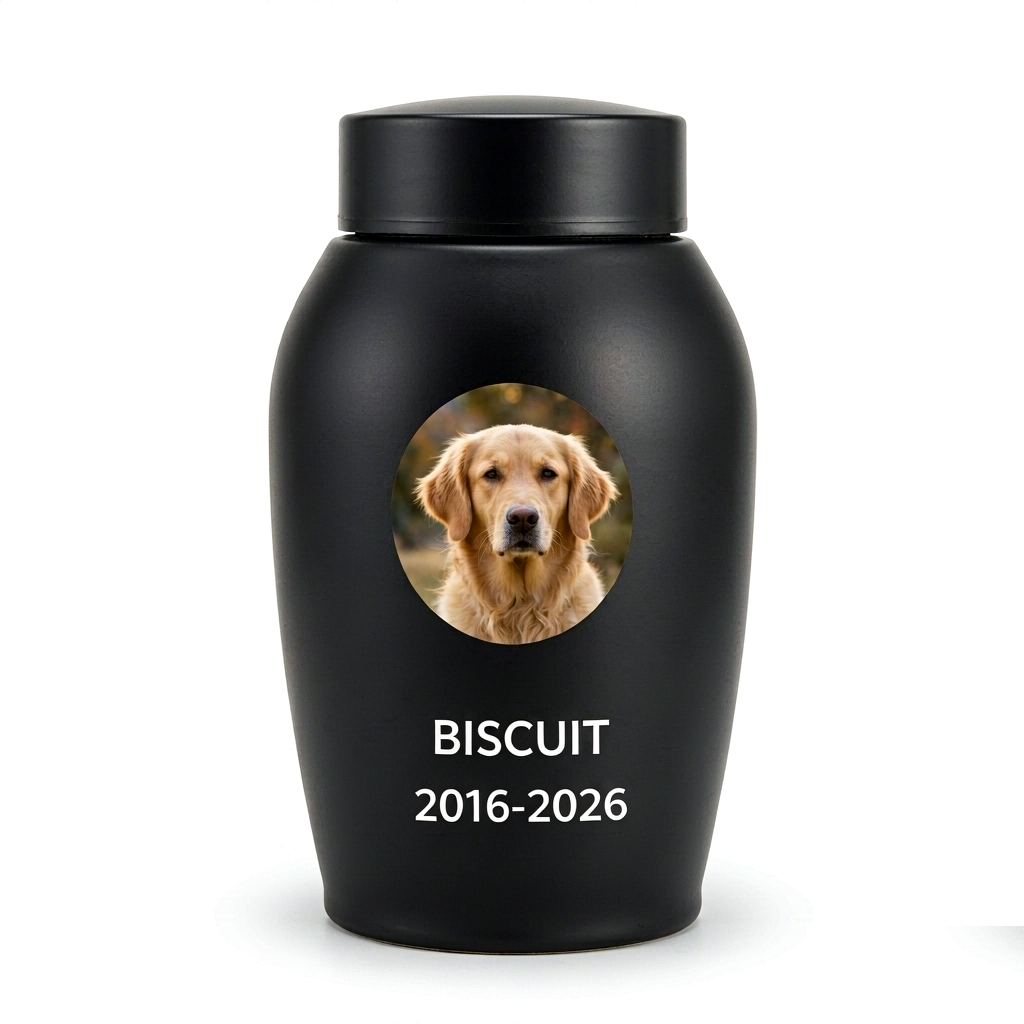
6 cm wide by 8 cm tall, matte-finish ceramic, with a printed photographic portrait and engraved-style name and life dates.
This suits a household that wants a single focal point and does not want to divide the material. At this size it is a keepsake urn for small pets rather than a full-size interment vessel, which for a 5 kg cat is the correct scale.
Matte rather than gloss is a deliberate choice: it takes the fingerprint, it does not glare under a lamp, and a printed portrait reads better against it.
4. A Glass Pendant, When the Object Should Be Worn
7 cm diameter, hand-cut stained glass with copper-foiled lead lines, on a fine metal chain.
Stained glass suits cats unusually well. A cat is defined by outline — the curve of the back, the line of the ear, the tail — and cut glass reproduces outline exactly. What it does not reproduce is photographic likeness; the piece is an interpretation built from your cat’s colors and shape rather than a photograph.
This is an argument for choosing it instead of a portrait piece rather than in addition to one. It also happens to be the smallest object here, which makes it the one to order when time is short.
5. A Ceramic Dish, When the Object Is Functional
White glazed ceramic with a fine gold rim, photograph printed into the inner surface. Available in heart, square, round and wavy-edge forms. Roughly 140–200 g depending on the shape.
This holds rings, small keepsakes, or a modest share of ashes. It works as a memorial object because it is used rather than displayed — a dish on a dressing table gets emptied and refilled daily, which means the photograph is seen without being looked at.
For a household where a display object would feel like too much, a dish is the version that gets lived with.
6. A Resin Portrait, When the Likeness Is the Whole Point
2.5 cm tall, about 8 g, light-curing resin, sculpted from your photograph in realistic or cartoon style, with a keyring loop.
This is the smallest three-dimensional option and the one that depends most heavily on the photograph. It works from fine detail, so a long-haired cat with soft texture is harder than a short-haired one, and a photograph that is sharp and unfiltered is close to mandatory.
At 2.5 cm it is a desk object or a keyring, not a mantelpiece. It is the answer to “I want to hold their face,” which is a different request from “I want to remember them.”
Why a Cat Portrait Is a Harder Problem than a Dog Portrait
Worth explaining, because it affects which of the six you should buy.
Cats photograph well in profile. The line from nose to ear to the curve of the back is a clean silhouette. Side-on light gives that silhouette strong contrast, which is exactly what engraved metal and cut glass need.
Cats photograph badly head-on. A front-facing cat face in flat light has very little modeling. A dog tolerates this because of the nose and the brow ridge; a cat’s face is flatter and the features are smaller relative to the skull.
Whiskers carry most of a cat’s expression. They are the first thing editing software smooths away, and they are the last thing to look natural in a stylized medium. A portrait made from a heavily filtered cat photograph will read as generic.
Long-haired cats lose their identity in soft media. A Ragdoll and a Birman look similar as photographs and diverge in three dimensions. Sculpted resin holds the difference; printed glass does not.
The practical conclusion: for a long-haired cat, prefer a sculpted or engraved medium over a printed one. For a short-haired cat with a sharp profile photograph, almost anything works.
The Photograph, Specifically for Cats
Take it at their eye level. Looking down at a cat produces a photograph where the skull dominates and the face shrinks.
Side-on, with light from the side. A window and a cat facing the window gives you the outline. This is the single most useful thing you can do for a future portrait.
Leave room around the head. Ear tips and the line of the back carry the proportions. A tight crop loses them.
Do not filter. Whiskers, fur direction and the small marks around the muzzle are what make the likeness identifiable.
One clear face. Not a group shot, not a photograph where the cat is half out of frame.
What Not to Keep
A short list that saves money and confusion.
A photograph already on the wall. If you have five cat photographs framed, a sixth photograph-based keepsake adds nothing. In that case the hair keyring, the small urn or the resin portrait adds something material instead.
A full-size urn for a 4 kg cat. A 1700 ml vessel holding a 150 ml portion is a large object holding a small amount. Nothing wrong with it, but it should be a deliberate choice rather than the only one.
Anything requiring a decision you cannot make yet. Buying in the first forty-eight hours is the most common sequence mistake. The capacity decision is the one that cannot be undone later.
Where a Cat Ends up Matters, and Cats Have Particular Places
The general advice is to put the urn where the animal spent their time, because association does more work than convention. For cats that advice is unusually specific, because cats have a small number of habitual spots and they return to them relentlessly.
The windowsill. The single most common cat place. A cat on a windowsill is a cat who watches something outside, which for an indoor cat is the largest part of their world. An urn or a photograph there keeps that association intact in a way a dedicated memorial shelf does not.
The warmest chair. Often the one nobody else likes, which is why nobody sits there after they are gone. An object on that chair claims it without displacing anyone.
The end of the bed. Cats that are permitted on furniture end up here, and it is where many people find themselves in the first weeks without meaning to. This is worth thinking about carefully rather than by accident — an urn at the foot of a bed you cannot sleep in is a problem, and one on a shelf is not.
Under a table or behind a door. Where cats go when they are ill or hiding. Less obvious as a display location, which has a certain use: it is where you can put something you want in the house but not in sight.
None of this requires an urn. All of it applies to whichever of the six you choose, because the location rather than the object is what does the remembering.
When the Decision Belongs to More than One Person
Cats are often shared in a way dogs are not — two households, a parent and an adult child, a couple who acquired the cat together and separated. This makes the keepsake decision unusually social.
Decide whether the material is divisible before anyone has an opinion. A cat’s total volume is small enough that two or three vessels is entirely practical. This removes the worst version of the argument, which is about who deserves to have it, by making the question about logistics instead.
Ask what each person wants to hold. “Do you want something that holds them, or something that carries their face” resolves in one exchange what weeks of guessing will not. Some people want the material; some want the image. Both are legitimate and they are not substitutes for each other.
Watch for the person nobody is checking on. Usually the person who functioned best in the first weeks — the one who handled the clinic call, the paperwork, the calls to relatives — is the one nobody asks what they want. They end up holding everything by default. Asking them directly is the single most useful thing anyone in the household can do.
A small object for someone far away. A keyring goes in a pocket and is seen daily. An urn on a shelf in someone else’s house is visited occasionally. If the person who was not present lives in another city or another country, an object that travels does more work than one that sits.
The Decision in Two Minutes
If you have read the above and are still choosing between six objects, this is the shortest route.
Do you need to hold the remains? If yes, an urn, sized from the weight table above. If no — or not exclusively — a hair keyring or a resin portrait does different and equally valid work.
Is the photograph sharp and unfiltered? If yes, a resin portrait or a printed ceramic piece. If it is soft or heavily edited, an engraved metal piece or cut glass, which are less dependent on fine detail.
Is there already a cat photograph framed in the house? If yes, avoid another photograph-based object. Choose something that carries material instead: the hair keyring or the small metal urn.
Where will it live? A shelf, a windowsill, a pocket, a dressing table, a garden. This usually decides it faster than any feature comparison.
That is the whole decision. Everything else — the gold rim, the wood grain, the LED color — is taste rather than suitability, and taste is not something a specification settles.
Two Photographs Worth Taking While You Still Can
Practical, and slightly urgent, because it only works while the cat is here.
One side-on in window light. The outline photograph. This is the one that works for engraved metal and cut glass, and it is the hardest to get later because it requires a cat who is sitting still and a window.
One at eye level, facing you, in flat indoor light. Lower value than the first, but it captures the front of the face which the outline does not. Useful as a second reference for a sculptor.
Neither needs to be a good photograph. They need to be unedited, sharp enough to see the whiskers, and close enough that the ear tips are in frame. A phone at arm’s length achieves both.
If the cat is elderly or unwell, take them this week rather than when you intend to.
A Short Version
Cats are under 6 kg, which means the volume question is simple: roughly 250 ml of capacity covers a typical adult cat, and a little more if aquamation was used.
Decide whether the material needs to travel or be divided. If it does, a small metal urn at 1.5 or 3 cm. If it does not, and the photograph is what you want to keep, a resin portrait or a printed ceramic piece.
If your cat shed onto the sofa and you have not vacuumed since, collect that hair this week. It is the only material in this article that becomes impossible to replace, and it costs nothing.
And if the photograph is not sharp enough, an engraved metal urn with just the name and dates is a legitimate answer rather than a fallback. The engraving will still be there in twenty years. There is no version of this decision that arrives later and works better; there is only the version you can live with, and every one of the six qualifies.
Common Questions About Ordering
How far ahead should I order for a specific date? Four to six weeks from artwork approval. If you want it to arrive by a particular day, artwork needs approving roughly six weeks before — five if the recipient is overseas, to allow for a customs queue.
Can the photograph be of more than one cat? One clear face is what gets made. If you have two cats, that is two objects, and the shipping is a flat $60 so ordering them together costs one rate rather than two.
Do these keepsakes work for a kitten? Yes, but a kitten’s photograph is a poor likeness source because the proportions change so quickly. If the cat died young, a photograph from later than you would ideally choose is better than a poor original — a kitten portrait may not read as them at all.
Is there a difference between a keepsake urn and a full-size urn? Yes, and it is about capacity rather than quality. The ceramic pieces here are keepsake-scale: correctly sized for a domestic cat and deliberately not designed to inter. If you want a vessel intended for burial in a plot, that is a different category of product entirely.
What if I am not sure which of the six to get? Start with the hair keyring. It is the cheapest of the six, it is the one object that uses material nothing else can replace, and cats shed enough that you will not be short of hair. Urns and portraits can be commissioned later; a tuft of fur cannot be collected later.
The Rest of the Range, for Completeness
The six above are the ones that work specifically well for cats. Three others in the catalog are worth knowing about even though they were not in the list, because they are frequently the better answer for a particular household.
The slate garden stone — rectangular 15 × 20 cm, engraved with a paw print, the name and the life dates. Natural dark slate, weather-resistant, and the only outdoor piece in the range. If your cat is buried in a garden or a pet cemetery, this is what marks the plot. It is also the one piece here that ages visibly and well: slate does not look ruined, it looks settled.
The backlit frame — 23 cm wide by 16.5 cm in pale wood grain, with a printed acrylic panel glowing from behind on a single-color LED, USB powered. For a cat this works when the photograph is sharp; the caution is that a backlit panel washes out fine fur detail, so long-haired cats are a poorer fit than short-haired ones.
The dried-flower shadow box — 20, 25 or 30 cm, pressed flowers and a small printed photograph behind glass with a warm LED strip. The most decorative object in the range and the one that requires a suitable surface in a daylit room.
Between them, the six listed above and these three cover essentially every cat household: something to hold, something to carry, something to display, something to mark a grave, and something for a window.
What the Price Is Actually Going On
Worth being straightforward about, because the range from $39 to $649 invites the assumption that the difference is margin.
At the small end, a 7 cm glass pendant or a 1.5 cm metal charm is a small cut-and-assembled piece. Material cost is trivial. What you are paying for is the photograph preparation, the tooling setup, and handling one order rather than several thousand identical ones.
In the middle, the ceramic pieces and the acrylic frame are printed or engraved products. The photograph is prepared by hand and confirmed with you, then the piece is made to that file. The frame adds assembly and wiring; the ceramic adds firing.
At the top end, a hand-painted ceramic urn is painted by a person, one at a time, after firing. The labor is the price, and it is why that piece takes longer and why its sizes are fixed rather than made to whatever volume you need — each size is a mold.
The useful question is not why one is more expensive. It is which object you will still be looking at in three years, because that is what you are actually paying for.
Two Things to Do This Week Rather than Later
Find out your cat’s weight if you can. If your cat has already gone, the clinic can give you the last recorded weight, and it is the same figure the crematorium uses. Everything downstream of capacity depends on it, and it is the one thing that cannot be recovered later.
Look for hair and put it in a labeled bag. In a jar, a bag with the date on it, anywhere dry. A cat sheds continuously, which makes this the easiest material in this entire article to collect and the only one that becomes impossible to replace.
Neither action takes more than a few minutes. Both are easier now than in a month.
If the Photograph Is Not Good Enough Yet
Worth saying directly, because people wait for a good photograph that never arrives and then commission from a bad one.
Some products are less dependent on the photograph than others. Engraved metal uses only the name and dates, so it does not matter that the photograph is soft. Cut glass interprets color and outline rather than reproducing detail, so a moderate photograph works. A printed ceramic portrait and a resin sculpture both need a sharp image.
If your only photographs are soft or filtered, an engraved metal piece is a legitimate way to make something now rather than a compromise. The name and dates cut into metal will outlast any print, and the absence of a photograph is a legitimate choice rather than a shortfall.
If your cat has distinctive markings, write them into the order. Tabby pattern, a white chest, one white paw, a notched ear. Any maker working from a photograph will use them, and naming them removes ambiguity when the image is not clear.
Timing and Cost, Plainly
Production runs 7 to 10 business days after you approve the artwork, not after you pay. Shipping is a flat $60 worldwide and transit is 15 to 25 days, the same for a $39 pendant and a $649 urn.
Total from approval to arrival is four to six weeks.
Prices across these six run $39 to $189. The ceramic dish and the small metal urn are $49, the compact ceramic urn $69, the resin portrait $189. There is a cheaper end and it is genuinely usable — the four objects under $70 cover every situation this article describes.
Common Questions
How much should a cat urn hold? About 35 ml of capacity per kilogram of body weight as a working figure, so a 5 kg cat needs roughly 250 ml. Step up a size for the sealed liner, and add twenty percent if your clinic uses aquamation.
What is the best memorial keepsake for a cat? There is no single answer, but the choice is easier than it looks. An object that holds the material if you need it to travel or be divided, and a hair keyring or resin portrait if you want something carried rather than displayed. Cats shed constantly, which makes the hair keyring unusually practical.
How much should I keep from my cat? The unedited photograph, any fur before it is vacuumed away, the collar and tag, and the weight and date. The weight is the one you cannot recover later, because it determines what any urn needs to hold.
Can ashes be split between two people for a cat? Yes, and for a cat the split is easy because the total volume is small. Our 1.5 × 2.5 cm metal charm and the 3 × 4 cm metal urn both exist for that, and a cat’s remaining volume is comfortably divisible.
Is stained glass a good medium for a cat portrait? Yes, and better for cats than for many dogs. Cut glass reproduces outline exactly, and a cat is defined by outline. What it does not carry is photographic detail, so treat it as a likeness built from color and shape rather than a picture.
Do you have a photo recommendation for cats? Side-on at their eye level with light from the side, one clear face unblocked, no filtering, and enough room around the head to keep the ear tips and the line of the back.
The Pieces Referred to Here
- Custom Pet Memorial Urn – Compact Black Ceramic Ash Urn with Photo, Name & Dates
- Miniature Pet Ashes Urn – Rose Gold Metal Keepsake with Engraved Paw & Dates
- Paw Print Hair Keyring – Leather Keepsake with Window for Pet Fur
- Stained Glass Pet Portrait Pendant – Small 7 cm Heart Glass Keepsake
- Ceramic Keepsake Dish with Pet Photo – White Glazed Gold-Rim Bowl
- 3D Pet Portrait Resin Bust – Hand-Sculpted Photorealistic Dog or Cat Head
Each piece is made to order from one photograph, so the choice between them is where it sits, what it is made of, and whether it holds anything.
Pieces Mentioned Here
Every piece is made to order from your own photograph, so no two are the same.
Questions People Ask
- How much should a cat urn hold?
- About 35 ml of capacity per kilogram of body weight, so a 5 kg cat needs roughly 250 ml. Step up a size for the sealed liner, and add twenty percent if your clinic uses aquamation rather than flame cremation.
- What is the best memorial keepsake for a cat?
- It depends on whether you want something carried or something displayed, and whether the material needs to be divided. A hair keyring is the most practical for a cat because cats shed constantly, which makes the material easy to collect and impossible to replace later.
- Is stained glass a good medium for a cat portrait?
- Yes, and better for cats than for many dogs. Cut glass reproduces outline exactly, and a cat is defined by outline. What it does not carry is photographic detail, so treat it as a likeness built from color and shape rather than a picture.
- Do I have to display an urn?
- No. Some households find an overt urn hard to live with permanently, which is a reasonable preference. Objects that carry a photograph or a tuft of fur instead of remains exist for that situation.